
Content last revised on October 23, 2026
Assembly Integrity & Layout Architecture: Evaluating Thermal Capacitance vs. Heat Sink Response for CM75DUM-12F
I check the heatsink contact surface and temperature-sensor connections before interpreting an overload trip on a CM75DUM-12F assembly. A case-temperature measurement can help assess cooling performance, but it does not directly capture the junction-temperature peak during a short load pulse. As a Design Consideration, distinguish the transient heating inside the module from the slower temperature rise of its mounting surface and heatsink.
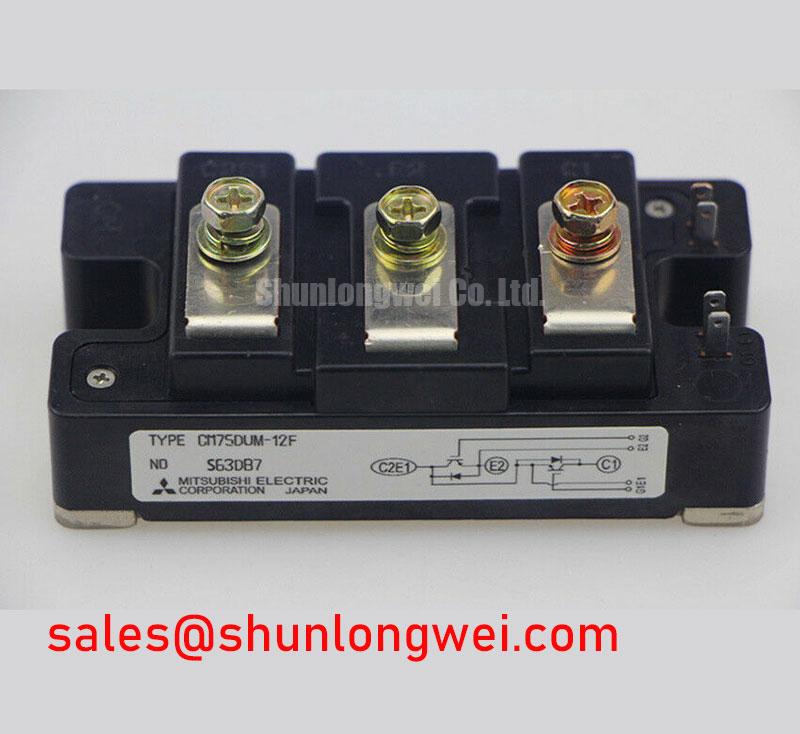
The Mitsubishi Electric CM75DUM-12F has the following electrical and thermal ratings. Values identified as typical describe characteristic behavior rather than guaranteed limits; electrical test conditions, thermal reference conditions, and insulation-test conditions must accompany these values when making acceptance decisions.
| Parameter | Symbol | Official Specification | Engineering interpretation |
|---|---|---|---|
| Collector-emitter voltage | Vces | 600 V | Blocking-voltage boundary against which operating voltage and switching overshoot are assessed. |
| Continuous collector current | Ic | 75 A at Tc 80°C | Current rating tied to the stated case-temperature condition. |
| Collector-emitter saturation voltage | Vce(sat) | 1.6 V typical | Conduction-loss reference; not a constant across current and temperature. |
| Total power dissipation | Ptot | 250 W per IGBT element | Thermally conditioned dissipation limit, not an unrestricted operating allowance. |
| Internal NTC resistance | R25 | 5 kΩ typical at 25°C | Temperature-sensing reference requiring the appropriate resistance-temperature characteristic. |
| Isolation voltage | Visol | 2500 V AC | Dielectric-test rating, distinct from permissible continuous working voltage. |
For pulsed-overload evaluation, use the manufacturer’s transient junction-to-case thermal impedance characteristic with the actual loss waveform. An Engineering Calculation using a multi-RC model represents the different thermal response times and accumulates the temperature contribution from successive pulses. Fit the network to that characteristic rather than assigning arbitrary thermal resistances and capacitances. Begin from the measured case temperature, include the preceding operating history, and assess the resulting junction-temperature peak against the applicable junction limit.
Do not treat the 250 W rating as a heatsink specification. Conduction loss, switching loss, duty cycle, interface resistance, and cooling conditions jointly determine the operating temperature. During assembly, inspect surface flatness, remove interface contamination, and apply the specified fastening sequence and thermal-interface process. Mechanical clearances should accommodate terminals and insulation barriers without allowing busbar loads to distort the mounting interface.
The internal NTC provides a useful thermal-management input, but its reading is not an instantaneous junction measurement. As a Design Consideration, use its calibrated response for temperature supervision and assess fast overload protection separately. Temperature cycling also differs from abrupt thermal shock; neither a general description nor a reference to MIL-STD-202 establishes qualification of this particular module. Qualification decisions require the applicable test method, conditions, and acceptance criteria.
CM75DUM-12F Operational Boundaries: Pre-Installation Junction Health Check
With the power stage isolated and its stored energy safely discharged, map the main terminals against the circuit diagram before applying a multimeter. For an unpowered diode-mode screening, disconnect parallel paths that would obscure the reading and hold the gate at emitter potential using an appropriate handling arrangement. Otherwise, a floating gate can change the apparent collector-emitter conduction during the check.
Check the antiparallel diode path in both meter polarities and compare corresponding switch positions under the same conditions. Record the instrument, polarity, and observed behavior rather than imposing a universal forward-voltage pass band. A persistent low-impedance path in both directions warrants investigation, but an in-circuit result can also include snubbers, discharge networks, and neighboring semiconductor paths.
Gate-emitter and gate-collector resistance checks can reveal gross conductive faults. They do not establish the specified gate leakage or prove full-voltage blocking capability. Formal leakage assessment needs a controlled, current-limited test arrangement with the correct terminal bias and acceptance limits. A diode-mode screening is therefore a useful pre-installation filter, not a substitute for electrical characterization.
As a Design Consideration, select gate-driver sourcing and sinking capability from the required gate-charge transition, the driver’s output impedance, and the external gate network. Peak-current capability alone is insufficient: the driver must also support repetitive gate charging without excessive supply droop or dissipation. External gate resistance influences switching speed, oscillation damping, and switching energy, so its final value belongs to the tested assembly rather than a generic module recommendation.
If the host board uses a bootstrap high-side supply, examine its charging interval at the actual modulation pattern. The capacitor must support the gate-charge demand and driver consumption between recharge opportunities. Inspect high-frequency current paths, capacitor parasitics, bootstrap-diode recovery behavior, and the driver’s undervoltage response. These are host-circuit considerations; they are not evidence that the CM75DUM-12F contains a bootstrap supply.
Keep the gate-drive return separate from the high-current emitter path wherever the documented terminal arrangement permits. Do not assign a Kelvin-emitter function to an unidentified terminal. A shared emitter connection introduces switching-related voltage into the apparent gate bias, which can complicate both measurement and control. Operating frequency should consequently be assessed through measured switching losses, driver loading, diode commutation, and thermal response—not inferred from the continuous-current rating.
CM75DUM-12F Circuit Protection & Reliability: Calibrating High-Frequency Commutation Loop Inductance
Capture collector-emitter voltage at the module terminals during controlled switching tests, using a suitably rated differential probe and a compact measurement connection. An excessive probe loop can add ringing to the trace and misdirect a protection review. Establish a repeatable measurement arrangement before comparing busbar revisions or snubber changes.
As an Engineering Calculation, the inductive contribution to turn-off overshoot is the commutation-loop inductance multiplied by the rate of current change; it adds to the DC-link voltage in a simplified switching model. Actual peaks also depend on capacitance, diode behavior, and damping. Use the 600 V blocking rating as a device boundary while the system engineer establishes an operating allowance for supply variation, load transients, and measured overshoot.
Pro Tip: As a Design Consideration, keep outgoing and return busbar paths closely coupled and geometrically balanced, then verify turn-off voltage margin with controlled double-pulse measurements.
Place local commutation capacitance to shorten the high-frequency current path, while preserving the required electrical clearances. Snubber selection should follow measured ringing behavior and the energy that the network must absorb. Capacitance, damping resistance, pulse-current capability, and dissipation interact; simply increasing capacitance can shift stress elsewhere in the circuit. Recheck terminal voltage and snubber temperature after each controlled revision.
Antiparallel-diode reverse recovery also affects turn-on current and voltage ringing. The recovery softness factor describes the relative portions of a reverse-recovery waveform, but no numerical softness value should be assigned to this module without its specified test data. As a Design Consideration, compare recovery waveforms at matched current, temperature, and switching conditions. A sharper recovery transition can increase high-frequency excitation, while the measured emission outcome still depends on layout and the surrounding equipment.
Separate differential commutation ringing from common-mode displacement-current paths when investigating interference. A module voltage rating does not establish equipment-level EMC compliance, and its isolation-test rating does not determine the enclosure’s working-voltage insulation design. For the broader relationship between switching stress, thermal cycling, and validation planning, the Power Electronics Masterclass provides supporting engineering context; service-life decisions still require application-specific evidence.
Benchtop Waveform Tuning: Mitigating Switching Stress on CM75DUM-12F
Compare the legacy driver’s gate waveform at the module terminals before changing its turn-on or turn-off resistance. Capture gate-emitter voltage alongside collector-emitter voltage and collector current so that a resistor change can be related to switching energy, overshoot, and commutation behavior. A waveform measured only at the driver output can conceal voltage developed across the connecting conductors.
Where the driver supports separate turn-on and turn-off paths, evaluate them independently. Increasing turn-on resistance can moderate current rise and diode-recovery excitation, but it also changes switching loss. Adjusting the turn-off path changes the balance between voltage overshoot, switching duration, and susceptibility to parasitic turn-on. As an Engineering Recommendation, retain the original circuit as a documented baseline and change one element at a time.
Check the inactive switch’s gate voltage during opposite-switch commutation. Miller-coupled current and shared return impedance can produce a transient gate excursion without a commanded turn-on. Evaluate the driver’s sinking path, gate-loop geometry, and any existing clamp function against that observation. Changing resistance alone should not be assumed to correct a poor return path or an unsuitable driver supply.
For replacement assessment, CM75E3Y-12E can be included in a documented comparison, but it should not be treated as a verified drop-in replacement. Compare circuit topology, terminal assignment, mounting geometry, thermal characteristics, gate requirements, and diode behavior before considering installation. The same process applies when evaluating a CM75DUM-12F IGBT module for a commercial string inverter or micro-grid energy-storage power stage: compatibility depends on the actual converter architecture and operating envelope.
Complete tuning across the intended load, supply, and temperature conditions rather than accepting a clean trace at a single operating point. Check driver-supply recovery, protection response, inactive-gate excursions, and accumulated temperature rise. Record the final gate-network configuration together with probe locations and test conditions so that subsequent maintenance can reproduce the electrical acceptance check.