

Content last revised on September 10, 2026
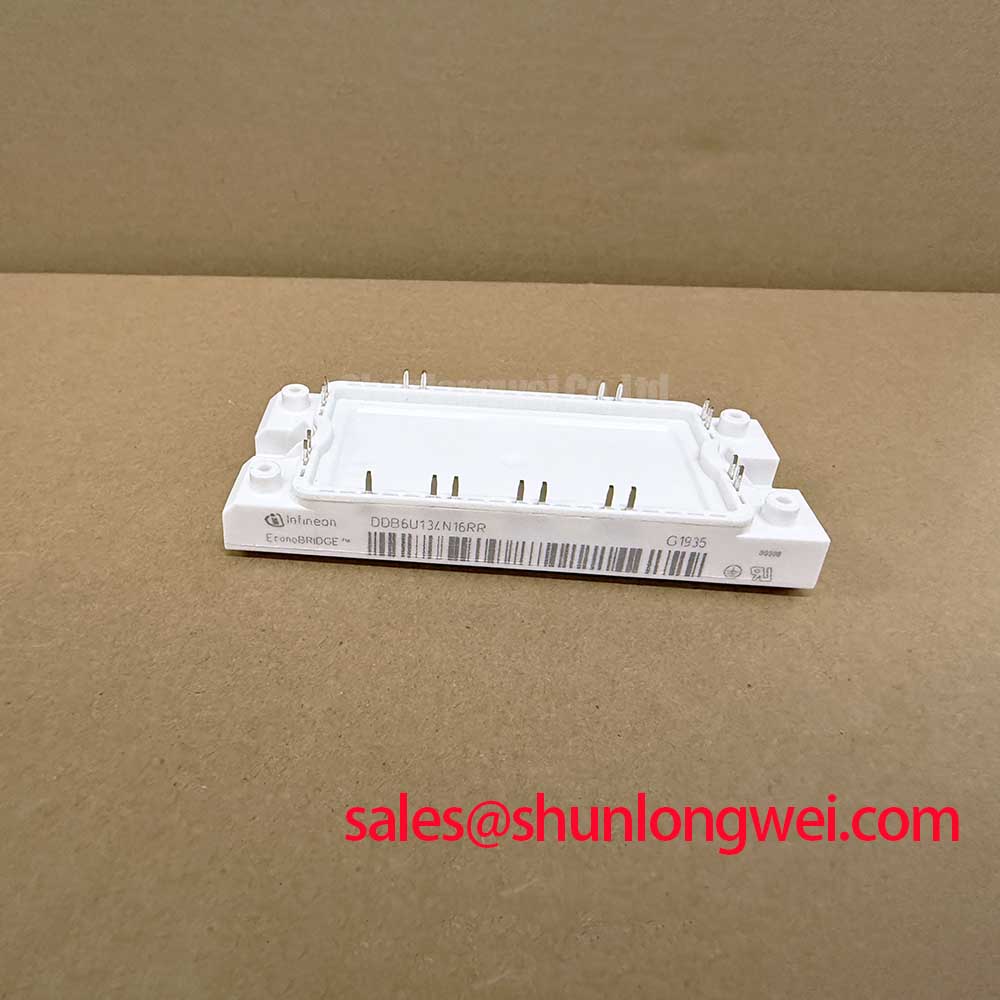
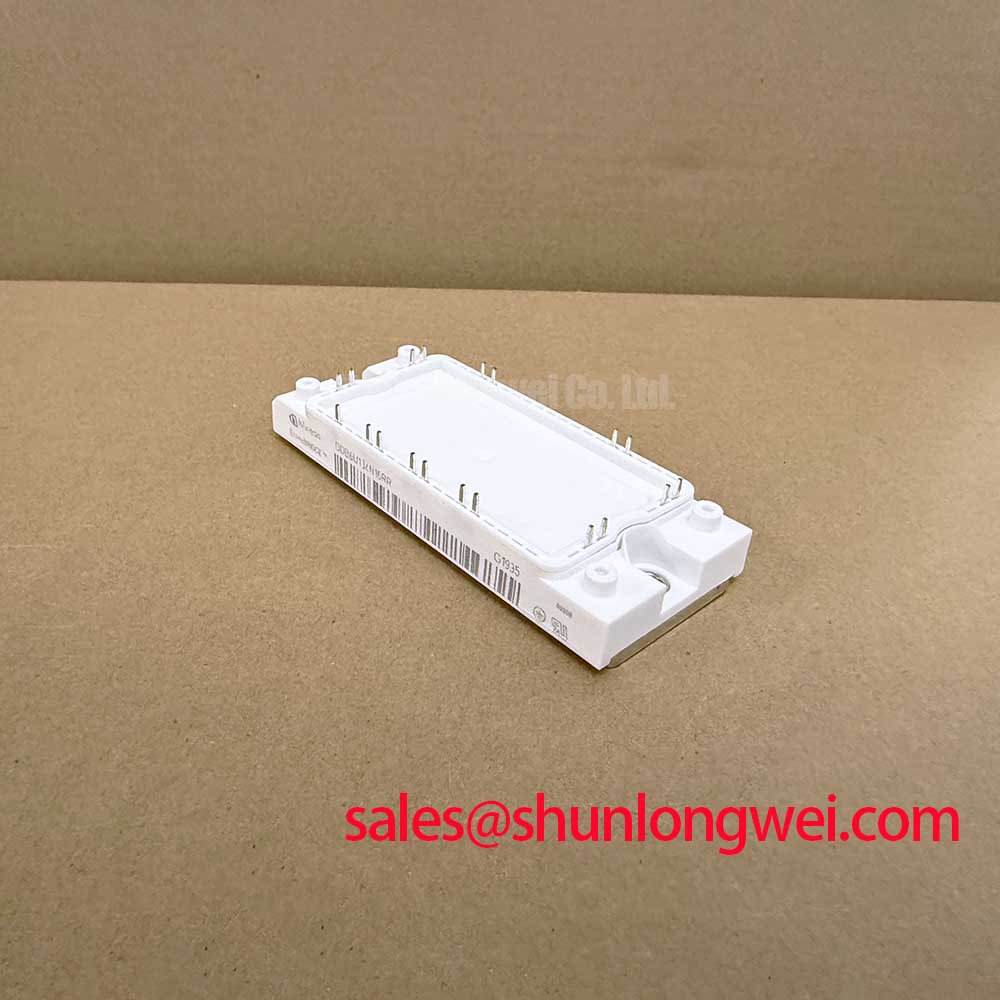
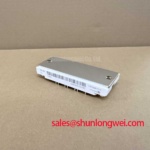
DDB6U134N16RR Infineon 1600V 134A Three-Phase Bridge Rectifier Module
How can engineers reduce the footprint of a high-current input stage while maintaining precise thermal oversight? The DDB6U134N16RR addresses this challenge by integrating a full three-phase rectifier bridge and a Negative Temperature Coefficient (NTC) thermistor into the low-profile EconoPACK™ 2 package. By consolidating six discrete power diodes and a temperature sensor into a single, high-density housing, this module provides 1600V of blocking voltage and 134A of continuous current capability, optimized for the front-end conversion of industrial Variable Frequency Drives (VFDs) and Servo Drives.
UVP: High-density three-phase rectification with integrated thermal sensing in an industry-standard EconoPACK™ 2 footprint for space-constrained industrial power stages.
- Top Specs: 1600V | 134A | Rth(j-c) 0.65 K/W
- Key Benefits: Simplified assembly; precision thermal monitoring.
For industrial systems prioritizing high-density input stages, the DDB6U134N16RR is the optimal choice to ensure reliable AC-to-DC conversion in 400V-480V line environments.
Frequently Asked Questions
Addressing Implementation Challenges and Design Validation
Is the DDB6U134N16RR suitable for 480V AC line voltage fluctuations?
Yes. With a repetitive peak reverse voltage (V_RRM) of 1600V, the module provides a significant safety margin for 400V and 480V AC lines. This 1600V rating effectively handles transient spikes and line surges common in heavy industrial environments, protecting the downstream DC-link capacitors and IGBT inverters.
What is the specific advantage of the integrated NTC thermistor for system protection?
The integrated NTC thermistor allows the system controller to monitor the module’s baseplate temperature in real-time. This eliminates the need for external sensors and provides a more accurate thermal reading of the silicon’s environment, enabling proactive derating or shutdown before an over-temperature event causes failure. Understanding thermal resistance is critical here for accurate temperature mapping.
How does the 1150A surge current (I_FSM) rating impact input filter design?
The maximum forward surge current of 1150A (at 10ms, 25°C) indicates high ruggedness against inrush currents during startup or sudden load changes. This robust I_FSM capability often allows for a more compact and cost-effective input fuse and filter selection, as the module can absorb significant energy pulses without degrading.
Can this module be used in parallel for higher power applications?
While diode bridges can be paralleled, it requires careful attention to trace impedance and thermal symmetry to prevent current hogging. For systems requiring even higher current handling, engineers often evaluate larger footprints or the related DDB6U205N16L, which offers a higher current rating in a similar package family.
Key Parameter Overview
Decoding the Specs for Enhanced Thermal Reliability
The technical parameters of the DDB6U134N16RR define its performance ceiling in high-efficiency power stages. The following table highlights the critical indicators for the Infineon EconoPACK™ 2 rectifier.
| Parameter Symbol | Technical Specification | Engineering Value |
|---|---|---|
| V_RRM | 1600 V | High Blocking Margin for 480V Lines |
| I_D | 134 A (at T_C = 80°C) | Robust Continuous Current Output |
| I_FSM | 1150 A (10ms, T_j = 25°C) | Superior Inrush Surge Tolerance |
| R_thJC | 0.65 K/W (per diode) | Efficient Heat Transfer to Heatsink |
| T_vj op | -40°C to 150°C | Stable Operation in Harsh Conditions |
| Package | EconoPACK™ 2 | Industry-Standard Low-Profile Design |
Download the DDB6U134N16RR datasheet for detailed specifications and performance curves from the official Infineon portal.
Technical Deep Dive
Optimizing Thermal Management via NTC Integration and Package Physics
The DDB6U134N16RR utilizes a Copper Baseplate design within the EconoPACK™ 2 housing to minimize Thermal Resistance (R_thJC). In power electronics, think of thermal resistance as a bottleneck in a pipeline; the lower the resistance, the faster heat flows away from the sensitive silicon junction. With a junction-to-case resistance of 0.65 K/W per diode, this module ensures that even at a continuous 134A, the heat generated is efficiently dissipated through the baseplate to the external thermal management system.
The inclusion of the NTC thermistor is a strategic advantage for TCO (Total Cost of Ownership). By placing the NTC in close proximity to the diode chips, the module provides a "thermal pulse" of the system. This allows for tighter design margins, as engineers can rely on real-time data rather than worst-case theoretical models. For those integrating this module into larger inverter systems, referring to the Field Engineer’s Handbook can provide additional insights into failure mode prevention.
Furthermore, the EconoPACK™ 2 package uses PressFIT or solder-mount pins (depending on the specific sub-variant) that are optimized for high-vibration industrial environments. The mechanical robustness of the Infineon module ensures long-term contact reliability, a vital factor when the module is subjected to the thermal cycling inherent in motor drive applications.
Application Scenarios & Value
Achieving System-Level Benefits in High-Frequency Power Conversion
Engineers often face the challenge of designing Variable Frequency Drives (VFDs) for compact industrial cabinets. In a typical VFD, the DDB6U134N16RR serves as the critical entry point, rectifying the incoming three-phase AC into a stable DC voltage. A specific challenge in these scenarios is the high startup surge of induction motors. The 1150A I_FSM rating of this module ensures that the front-end rectifier remains undamaged during the heavy inrush current seen when a conveyor system or industrial fan initiates movement.
In Uninterruptible Power Supplies (UPS) and Solar Inverters, the 1600V blocking capability is equally essential. It provides the necessary insulation coordination required by standards such as IEC 61800-3, ensuring that line transients do not punch through the rectifier stage. For designers building 800V platforms or complex motor controllers, comparing this module with integrated solutions like the SKiiP24NAB12T4V3 may reveal opportunities for even higher levels of system integration.
Strategically, adopting the DDB6U134N16RR simplifies the bill of materials (BOM). Instead of sourcing six discrete diodes and a separate thermistor, procurement teams manage a single Diode Module. This reduces assembly time, minimizes the risk of component misalignment on the PCB, and streamlines the thermal interface design, ultimately lowering the system-level cost while enhancing overall reliability in Industrial 4.0 automation frameworks.
The DDB6U134N16RR represents a mature, high-reliability solution for the rectification needs of modern industrial electronics. As the industry moves toward higher power densities and smarter thermal monitoring, the integration of 1600V diode technology with internal NTC sensors remains a cornerstone of robust power stage design. For engineers transitioning from discrete components to modular architectures, this EconoPACK™ 2 module provides a proven path to balancing performance, space, and thermal precision.