Content last revised on September 10, 2026
How can power system designers minimize thermal stress failures in 1700V/1200A high-power traction or wind energy applications?
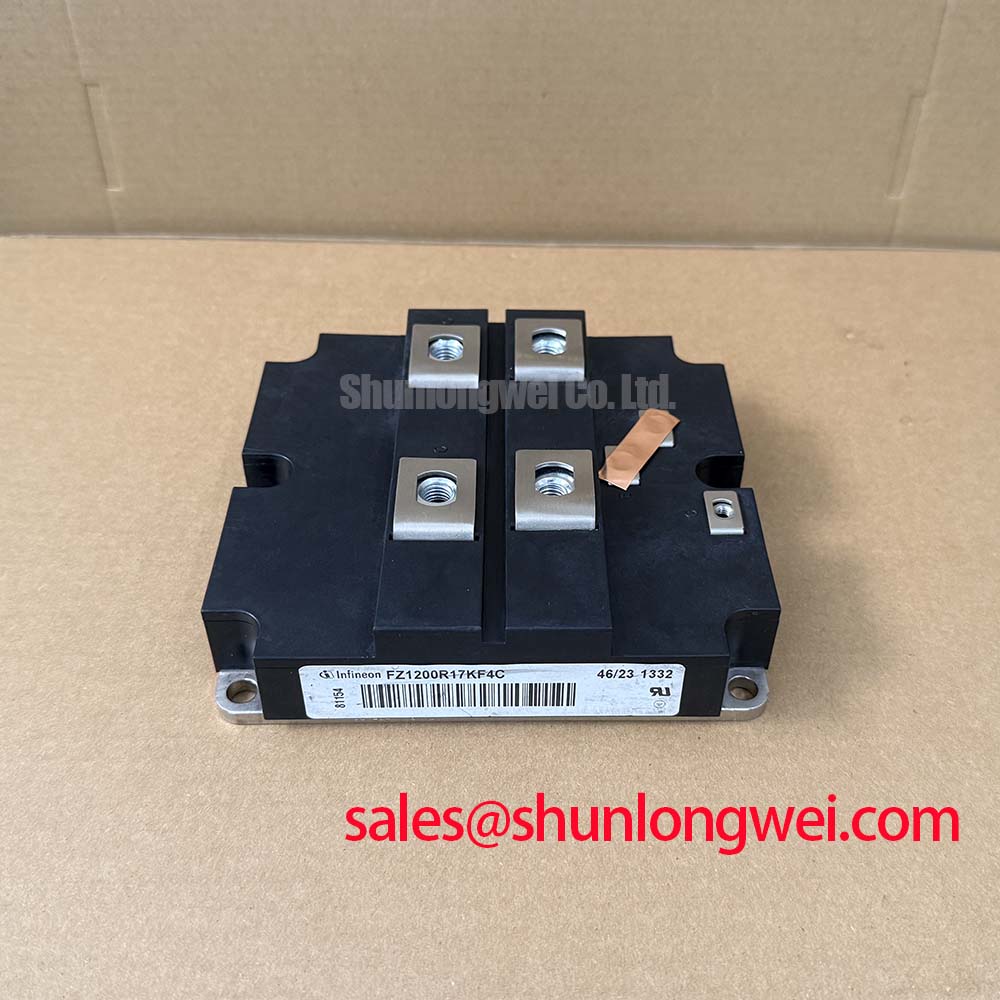
Engineering robust power conversion stages requires addressing the fundamental challenge of thermal expansion mismatch. In high-power modules, the interface between the silicon die and the baseplate is a primary failure point. The FZ1200R17KE3, a high-performance IGBT Module manufactured by Infineon, solves this through its specific material science, offering 1700V and 1200A ratings in a standard IHV 190mm package. By utilizing an AlSiC baseplate, this module balances mechanical strength with thermal conductivity, essentially acting as a thermal expansion "buffer" that extends service life in cycling-heavy environments. This design is the optimal choice for multi-megawatt systems where uptime is non-negotiable and maintenance costs are high.
UVP: Superior thermal cycling reliability through AlSiC baseplate technology for 1700V/1200A high-power demanding environments.
Core Specs: 1700V | 1200A | Vce(sat) 2.00V. Engineering benefits include reduced thermal fatigue and simplified paralleling for multi-stack converters. What is the primary benefit of its AlSiC baseplate? It matches the coefficient of thermal expansion (CTE) of the internal ceramics, preventing delamination over thousands of power cycles.
Frequently Asked Questions
Addressing Core Engineering Queries on High-Power Switching
How does the AlSiC baseplate of the FZ1200R17KE3 improve long-term reliability compared to traditional copper?
Unlike traditional copper baseplates, AlSiC (Aluminum Silicon Carbide) has a coefficient of thermal expansion that closely matches the AlN (Aluminum Nitride) ceramic substrate. This minimizes the mechanical stress on the solder layers during temperature fluctuations. For engineers, this translates to significantly higher Power Cycling Capability, making it ideal for the intermittent loading found in Wind Turbine converters.
What are the implications of the 2.00V Vce(sat) for high-current system efficiency?
At a continuous current of 1200A, even millivolt variations in Vce(sat) impact thermal load. The FZ1200R17KE3 achieves a typical Vce(sat) of 2.00V at its rated 1200A. This relatively low saturation voltage reduces conduction losses, which allows for smaller heatsink footprints or higher power density in the final Inverter design. Reducing these losses is critical for meeting the efficiency requirements of high-efficiency power systems.
Key Parameter Overview
Functional Grouping of Specifications for Precise Design Mapping
| Functional Category | Parameter Symbol | Typical/Max Value |
|---|---|---|
| Voltage Ratings | Vces (Collector-Emitter Voltage) | 1700V |
| Current Capacity | Ic (Continuous DC Current at 80°C) | 1200A |
| Switching Performance | Vce(sat) (Saturation Voltage) | 2.00V |
| Thermal Dynamics | Rth(j-c) (IGBT Thermal Resistance) | 11.0 K/kW |
| Diode Specs | If (Forward Current) | 1200A |
| Mechanical | Weight / Package Type | 1900g / IHV 190mm |
Download the FZ1200R17KE3 datasheet for detailed specifications and performance curves.
Technical Deep Dive
Advanced Material Integration for Enhanced Thermal Management
The FZ1200R17KE3 is built upon the IGBT3 trench/fieldstop architecture. This technology is designed to provide a "soft" switching characteristic, which reduces EMI and limits voltage overshoots during high-speed turn-off. However, the true engineering distinction lies in its internal thermal stack. By using Aluminum Nitride (AlN) as the isolation ceramic, the module achieves low Thermal Resistance (11.0 K/kW for the IGBT section), ensuring that the heat generated at the junction is efficiently conducted to the AlSiC baseplate.
Think of the AlSiC baseplate as a "thermal shock absorber." In standard copper-baseplate modules, the baseplate expands much faster than the silicon and ceramic above it, creating a "bimetallic strip" effect that bows the module and stresses the solder. AlSiC moves in sync with the internal layers, preserving the integrity of the thermal interface material (TIM) over the system's life. This reliability is a cornerstone for designing optimal thermal management strategies in large-scale drives. For systems requiring even higher current handling, the FZ2400R17HP4_B2 offers an alternative in the same 1700V family.
Application Scenarios & Value
Maximizing Uptime in High-Power Industrial and Infrastructure Assets
For Wind Turbine inverters prioritizing thermal margin, this 1700V module is the optimal choice. In the renewable energy sector, modules are subjected to rapid thermal cycling due to wind gusts. The FZ1200R17KE3 addresses this with its ruggedized package, ensuring that the 1200A output remains stable even under fluctuating load conditions. This contributes directly to a lower Total Cost of Ownership (TCO) by reducing the frequency of field replacements in offshore environments.
In Traction applications—such as locomotives and heavy-haul rail—the module provides the necessary current density to drive large motor stacks while maintaining Short-Circuit Safe Operating Area (SCSOA) limits. Its compatibility with standard Gate Drive solutions and Kelvin Emitter configuration allows for precise control of switching speeds, which is vital for maintaining efficiency in wind-to-grid conversion and heavy industrial Variable Frequency Drives (VFD). If your design requires a lower current profile in a similar package, you might evaluate the FZ400R17KE3.
Strategic procurement of these modules supports long-term platform stability, especially in Industrial Drives where IEC 61800-3 compliance is required. The predictable switching behavior and robust SOA (Safe Operating Area) empower engineers to push the boundaries of power density without sacrificing the reliability expected by end-users in the mining or oil and gas industries.
To integrate this module into your next high-power converter design, consult with our technical specialists for logistics support and factual data verification. We provide the technical transparency needed to move from evaluation to deployment with confidence.