Content last revised on October 18, 2026
SKKT500-16E Operational Boundaries: Evaluating Non-Repetitive Surge On-State Current Limits
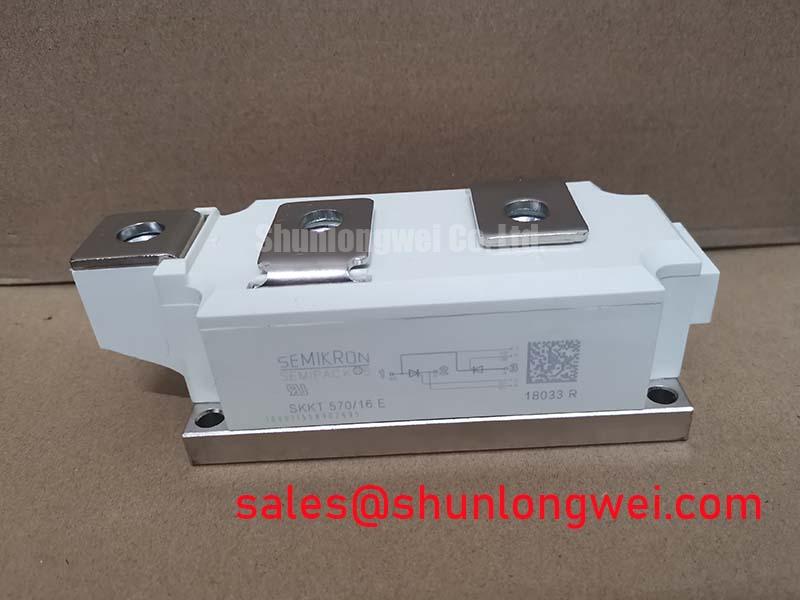
When a medium-frequency induction power supply shows abnormal commutation, disconnect and lock out the power supply, discharge stored energy, and verify the absence of hazardous voltage before inspecting or removing the module. Record the line and load conditions and confirm the installed device markings. The SKKT500-16E is a Semikron SEMIPACK dual thyristor module in the 1600 V, 500 A class. These values establish the product identity and rating class; the permissible operating point still depends on the circuit, cooling assembly, protection network, and the manufacturer’s complete electrical data, including the conditions attached to the current rating.
For maintenance work, inspect the main terminals for heat discoloration, confirm that cable lugs sit flat, and check that the clamping hardware matches the mechanical arrangement used by the original installation. Fuse coordination must be based on the applicable semiconductor fuse and the manufacturer’s stated I²t coordination data, rather than on the module current label alone. The same procedure applies when the part is evaluated for a medium-frequency induction melting or metal hardening power supply.
The non-repetitive surge assessment begins with the 10 ms half-cycle condition specified for the device’s ITSM characteristic. When reviewing a fault-clearing event, record the prospective supply condition, fuse response, and the number of previous high-current disturbances, and check the applicable surge conditions concerning reapplied voltage. Junction temperature is especially important because a module that survives one surge under a cold starting condition may have a different margin after sustained conduction.
Use the Semikron fuse coordination information for the selected fuse family and compare its clearing energy with the module’s permitted surge conditions. Do not treat the 500 A current class as an automatic fault-current allowance. Surge withstand, repetitive current capability, thermal resistance, and gate-trigger conditions must be checked separately in the device documentation.
Terminal work should be completed with clean contact surfaces, correctly supported conductors, and the specified tightening torque for the actual Semipack assembly. Recheck the connection after thermal cycling if the equipment manufacturer’s maintenance procedure requires it. The Semikron reference page for SEMIPACK® thyristor and diode modules provides the relevant product-family context.
SKKT500-16E Operational Boundaries: Evaluating Power Factor Degradation and Harmonic Mitigation Limits
In a phase-controlled rectifier, firing-angle adjustment changes the relationship between the AC source and the rectified load. As the control angle moves across the topology’s permitted operating range, the average transferred energy, displacement power factor, reactive demand, and current waveform distortion must be reviewed together. A furnace controller that delivers the required DC output can still impose an unacceptable supply-side condition when the firing angle is routinely operated at a high value.
Commissioning should therefore capture phase voltage, line current, firing command, and DC load response at representative operating points. Review the voltage waveform for commutation notches and the current waveform for distortion, then assess whether the installed transformer, line reactor, and harmonic mitigation arrangement are suitable for the measured duty. MOV devices, snubbers, and other transient absorbers should be evaluated as part of the complete power topology; their voltage class and energy capability are system design matters, not automatic attributes of the SKKT500-16E.
| Selection reference | Product identification | Integration checkpoint |
|---|---|---|
| SKKT500-16E | Semikron; 1600 V; 500 A class; SEMIPACK dual thyristor module | Confirm firing circuit, fuse I²t coordination, cooling, and terminal hardware |
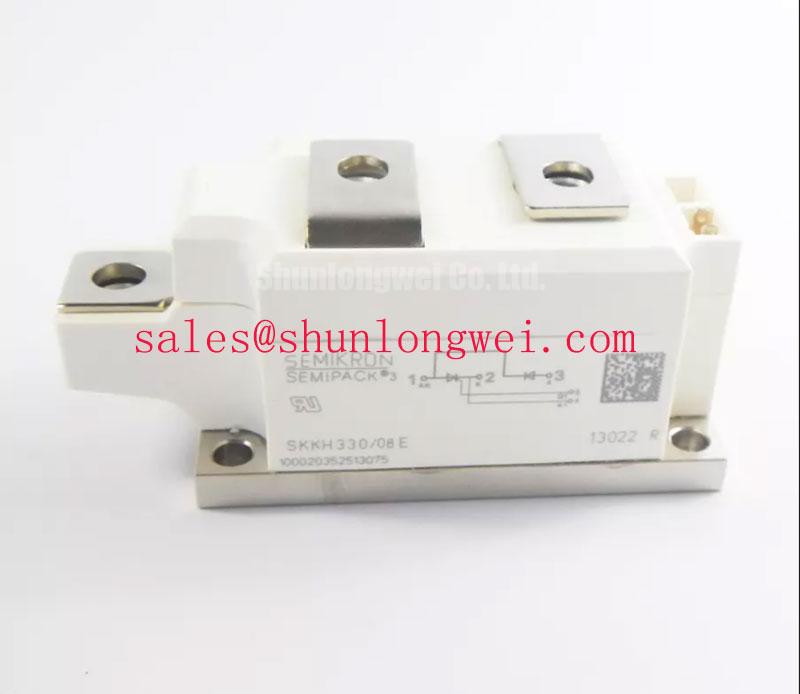
| SKKD101-16 | Separate diode-module reference, not a like-for-like thyristor replacement | Compare device function as well as documented voltage, current, package, and thermal data before any substitution decision |
In a front-end arrangement, the associated SKKD380 reference may be reviewed as a rectifier-stage comparison point. It should not be treated as an automatic companion part. Gate drive isolation, trigger timing, reverse-voltage recovery behavior, and the control system’s common-mode noise performance need to be checked against the original topology.
SKKT500-16E Operational Boundaries: Ensuring Uniform Heatsink Contact Pressure
Thermal verification depends on the complete path from the junction through the case and mounting interface into the heatsink. Inspect the copper baseplate contact area for contamination, burrs, uneven paste distribution, and signs of module distortion. Apply the thermal interface material as a thin, continuous layer appropriate to the module’s mounting instructions, then tighten the assembly progressively and evenly using the documented hardware torque.
After installation, compare temperature behavior across the available measurement points during a controlled load increase. A large difference between phases may justify checking contact pressure, airflow, paste condition, terminal resistance, and the balance of the firing circuit rather than assigning the result to the semiconductor immediately. Repeated thermal cycling can also expose mounting flatness problems that are not visible during a cold inspection.
Maintenance Note: Clean the heatsink and verify airflow during scheduled service while monitoring contact temperature against a known-good operating record.
Environmental control matters in furnace cabinets: remove conductive dust, prevent condensation during cold starts, and maintain suitable creepage and clearance for the actual system voltage. MOV coordination, gate-driver return routing, gate-pulse integrity, and common-mode shielding should be validated by the system engineer during switching and fault tests. This conventional thyristor is not turned off by a negative gate command; turn-off depends on the circuit providing the required current-zero and recovery conditions. The thermal-management principles discussed in The Advanced Thermal Management Revolution are useful when reviewing the wider cooling architecture around the module.