
Content last revised on September 10, 2026
Semikron SKM200GB125D IGBT Module: Technical Analysis & Application Overview
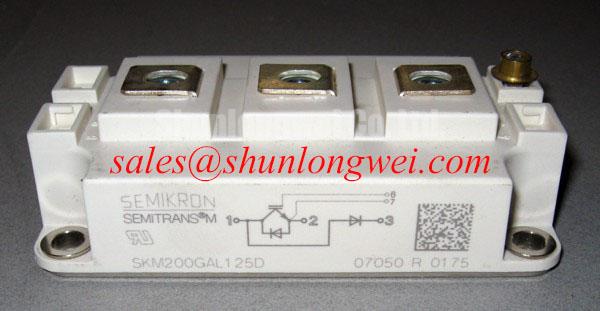
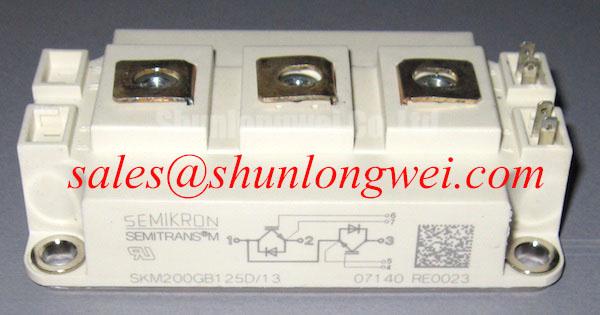
The Semikron SKM200GB125D delivers high-frequency switching efficiency and structural robustness for demanding industrial power conversion systems. Featuring key ratings of 1200V collector-emitter voltage, 200A continuous collector current, and a low thermal resistance of Rth(j-c) 0.09 K/W, this module minimizes power dissipation in fast-switching topologies. Its ultrafast Non-Punch-Through (NPT) silicon structure limits tail current duration, while an isolated Direct Copper Bonding (DCB) baseplate ensures reliable long-term thermal management. Designed for high-speed operation, it provides stable performance in resonant inverters up to 100 kHz. For resonant inverters operating above 20 kHz, this 1200V 200A module provides an optimal balance of fast switching and thermal stability.
Application Scenarios & Value
Achieving High System Efficiency in High-Frequency Power Systems
Engineers often face severe thermal dissipation challenges when designing high-frequency switched-mode power supplies (SMPS) and resonant converters. In high-frequency induction heating units, continuous high-power switching increases total energy losses per cycle. The SKM200GB125D mitigates these thermal bottlenecks through its ultrafast NPT silicon design, which limits tail current duration and minimizes temperature-dependent switching losses during high-speed turn-off.
When deployed in industrial electronic welding equipment, rapid load swings require exceptional short-circuit endurance and soft diode recovery. The integrated CAL (Controlled Axial Lifetime) inverse diode exhibits soft recovery characteristics, avoiding severe voltage overshoots across the 1200V rated collector-emitter junction. This makes the module suitable for high-duty-cycle welding power supplies operating above 20 kHz switching frequencies. For additional design insights, explore the role of IGBTs in high-frequency induction heating and system-level power semiconductor selection.
For applications demanding higher continuous current handling within the SEMITRANS housing, the related SKM300GB128D provides expanded current margins, whereas lower-power stages can utilize the SKM100GB125D for scaled current demands.
Technical & Design Deep Dive
Evaluating NPT Ultrafast Silicon and CAL Diode Integration
The internal architecture of the SKM200GB125D relies on homogeneous NPT silicon technology. Unlike conventional Punch-Through (PT) devices, NPT IGBTs maintain a positive temperature coefficient for collector-emitter saturation voltage (VCE(sat)). This characteristic simplifies current sharing when paralleling modules and prevents localized hot spots under continuous thermal stress.
Thermal dissipation is governed by the isolated DCB baseplate, which achieves a junction-to-case thermal resistance of 0.09 K/W per IGBT. Think of this low thermal resistance as a wide thermal highway that conducts heat rapidly away from the silicon die into the heatsink, preserving safe operating margins. Understanding thermal resistance optimization is critical when sizing cooling assemblies for high power density.
The integrated CAL freewheeling diode functions much like a tuned shock absorber in a mechanical suspension. By controlling minority carrier lifetime, the CAL diode suppresses sharp reverse recovery current spikes, reducing electromagnetic interference (EMI) and voltage strain on surrounding driver circuitry. Designers can verify device boundaries using standard Safe Operating Area (SOA) guidelines and technical resources from Semikron Danfoss.
Key Parameter Overview
Datasheet Specifications and Electrical Limits
| Parameter Description | Symbol | Specification Value | Engineering Significance |
|---|---|---|---|
| Collector-Emitter Voltage | VCES | 1200V | Maximum off-state blocking voltage for 400V/480V line supplies. |
| Continuous Collector Current | IC | 200A (Tc=25°C) / 130A (Tc=80°C) | Continuous DC current capacity under thermal management. |
| Saturation Voltage | VCE(sat) | 3.3V (typ @ 150A, 125°C) | On-state conduction voltage drop across the IGBT chip. |
| Thermal Resistance (Junction-to-Case) | Rth(j-c) | 0.09 K/W (per IGBT) | Thermal transfer impedance from die to baseplate. |
| Short-Circuit Withstand Time | tpsc | 10 µs (VCC=600V, Tj=125°C) | Self-limiting fault tolerance rating (6 x ICnom). |
| Isolation Voltage | Visol | 4000V AC (1 min) | Dielectric insulation rating between terminals and baseplate. |
Frequently Asked Questions
Engineering Insights & Practical Design Queries
What makes the SKM200GB125D ideal for high-frequency switching?
Its NPT ultrafast architecture delivers minimal tail current and low switching energy losses above 20 kHz.
How does CAL diode technology benefit high-power inverters?
Fast and soft recovery characteristics significantly lower voltage spikes and reduce electromagnetic interference.
How does the 10 µs short-circuit withstand time assist driver design?
The 10 µs short-circuit withstand rating (tpsc) provides a defined margin for gate driver desaturation protection circuits to detect overcurrent faults and shut down safely before thermal destruction occurs.
Why is Direct Copper Bonding (DCB) essential for module reliability?
DCB technology bonds copper directly to an insulating ceramic substrate. This design offers high thermal conductivity while maintaining 4000V AC dielectric isolation between internal power circuits and the external heatsink.
What gate drive voltages are recommended for driving the module?
A standard turn-on gate voltage of +15V ensures full channel saturation. A negative turn-off bias between -5V and -15V is recommended to prevent parasitic Miller turn-on caused by high dv/dt switching transients.