

Content last revised on September 10, 2026
Optimizing Industrial Inverter Efficiency with the SEMIKRON SEMITRANS 2 Platform
Technical Highlights and Engineering Overview
Achieving High-Reliability Power Switching with NPT Technology
How do engineers minimize thermal runaway risks while maintaining high switching speeds in mid-range industrial drives? The SKM50GD125D addresses this challenge through its robust Non-Punch Through (NPT) IGBT architecture. Unlike earlier generations, this 1200V module offers a positive temperature coefficient for the collector-emitter saturation voltage, VCE(sat), which is typically 2.1V at a nominal current of 50A. This characteristic makes the device inherently suitable for parallel operation and prevents localized overheating, ensuring long-term structural integrity in demanding Three-Phase Bridge Inverter configurations. For 400V systems prioritizing thermal margin, this 1200V module is the optimal choice.
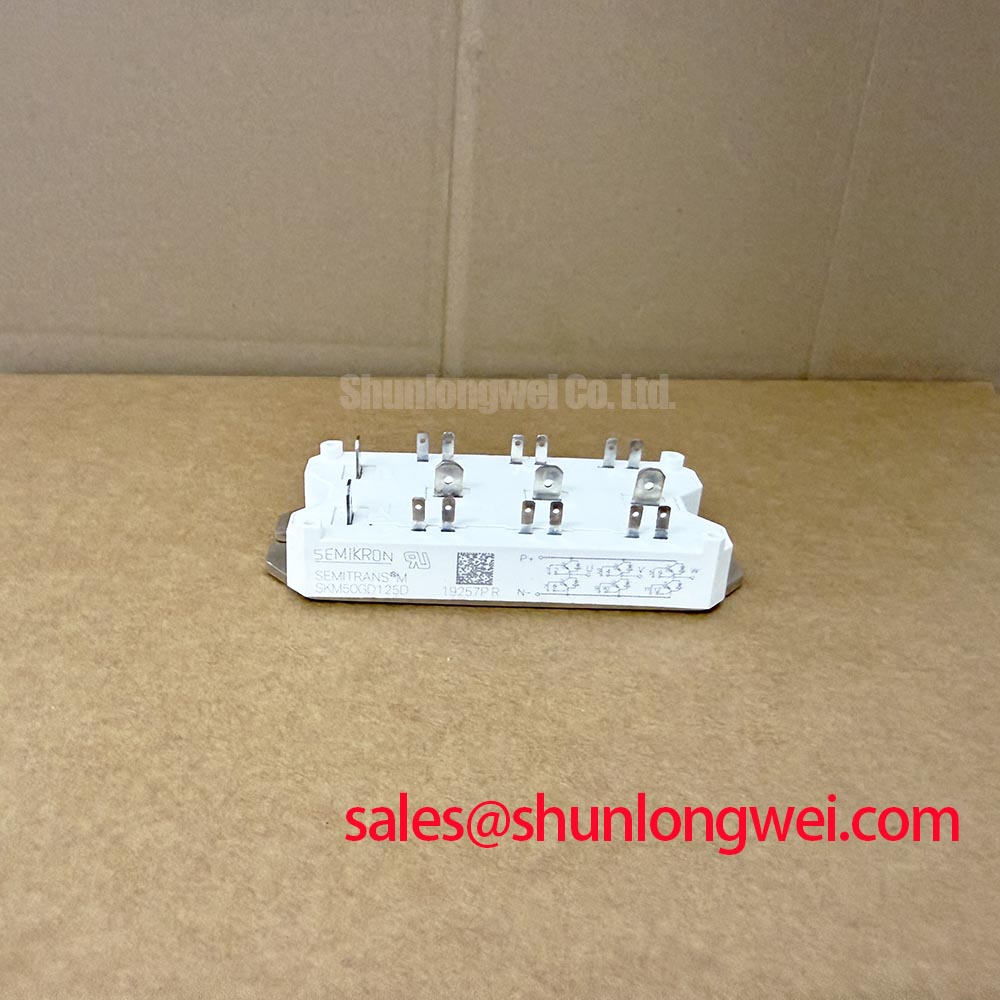
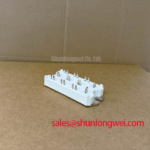
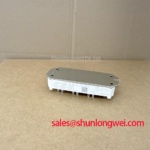
The module is housed in the industry-standard SEMITRANS 2 package, featuring an isolated copper baseplate utilizing Direct Copper Bonding (DBC) technology. This design significantly reduces Thermal Resistance, with a junction-to-case resistance Rth(j-c) of 0.35 K/W for the IGBT section. By facilitating rapid heat dissipation, the SKM50GD125D allows for higher power densities without compromising the 150°C maximum junction temperature limit. What is the primary benefit of its NPT structure? It provides a stable switching performance across the entire temperature range, significantly reducing the complexity of gate drive compensation.
Engineering Frequently Asked Questions
Solving Design Challenges in High-Voltage Power Conversion
How does the positive temperature coefficient of VCE(sat) in the SKM50GD125D simplify multi-module system designs?
In high-power arrays, the positive temperature coefficient ensures that as a specific IGBT heats up, its on-state resistance increases slightly, naturally forcing the current to redistribute to cooler modules. This self-balancing mechanism eliminates the need for complex active current-sharing circuitry, which is a critical advantage in large-scale IGBT Module assemblies.
Why is the integrated CAL (Controlled Axial Lifetime) free-wheeling diode essential for inductive load switching?
The SKM50GD125D incorporates CAL Diode technology that is optimized for soft recovery. This minimizes peak reverse recovery current and voltage spikes during high-speed switching of inductive loads, such as those found in AC Motor Speed Control. By reducing EMI and voltage stress, it protects the IGBT from potential latch-up and extends the overall system lifespan.
What impact does the low-inductance case design have on high-frequency UPS applications?
Parasitic inductance in power modules often leads to excessive voltage overshoots during turn-off. The SEMITRANS 2 package is engineered with a Low Inductance internal busbar, which allows the SKM50GD125D to switch at frequencies required for modern Uninterruptible Power Supplies (UPS) while keeping transient voltages within the Safe Operating Area (SOA).
How does the Rth(j-c) of 0.35 K/W influence the selection of heatsinks for industrial drives?
A lower Thermal Resistance means the module can transfer heat to the ambient environment more efficiently. For an engineer, this translates to the ability to use smaller, more cost-effective heatsinks or to operate the 50A module at higher ambient temperatures without exceeding the critical Tj(max) of 150°C.
Key Parameter Overview
Decoding Technical Specifications for System-Level Integration
The following technical data is extracted from the official manufacturer documentation to support precise hardware engineering and thermal modeling.
| Feature / Parameter | Specified Value | Engineering Significance |
|---|---|---|
| Collector-Emitter Voltage (Vces) | 1200 V | Provides ample headroom for 400V–480V AC line applications. |
| Continuous Collector Current (Ic) @ Tc=80°C | 42 A | Reliable current handling for mid-power industrial VFDs. |
| Saturation Voltage (Vce(sat)) @ 25°C | 2.1 V | Optimized for low conduction losses in steady-state operation. |
| Short Circuit Withstand Time (tsc) | 10 μs | Ensures sufficient time for protection logic to trigger. |
| Package Style | SEMITRANS 2 | Standardized footprint for ease of sourcing and mechanical design. |
| Topology | Sixpack (GD) | Complete three-phase bridge in a single compact module. |
Download the SKM50GD125D datasheet for detailed specifications and performance curves.
Technical Deep Dive
Material Science and Switching Dynamics in the SEMITRANS Architecture
To understand the SKM50GD125D, one must look at the synergy between its NPT IGBT chips and the CAL Diode technology. Think of the NPT IGBT as a high-speed precision industrial valve. While traditional valves might suffer from "fluid hammer" (current tails) when shut abruptly, the NPT structure allows the carrier plasma to exit the device predictably. This results in switching losses (Eon and Eoff) that remain stable regardless of temperature fluctuations, a vital trait for Variable Frequency Drives (VFD) operating in volatile environments.
Furthermore, the DBC ceramic substrate acts as a thermal highway. By bonding the copper directly to the alumina ceramic, Semikron eliminates the need for thick thermal interface layers that often act as bottlenecks. This is comparable to replacing a narrow dirt road with a multi-lane expressway, allowing thermal energy to flow from the silicon junction to the heatsink with minimal impedance. This mechanical robustness is why the SKM50GD125D is frequently specified in Servo Drive applications where frequent power cycling is the norm. For systems requiring even more compact integration, the SKM40GD125D provides a similar 1200V sixpack topology at a lower current rating.
Application Scenarios & Value
Achieving System-Level Benefits in Industrial Power Conversion
The SKM50GD125D is predominantly utilized in Three-Phase Inverters for AC Motor Speed Control. In these settings, the 10 μs short-circuit withstand time is a critical safety parameter, allowing enough time for a Gate Drive controller to detect a fault and shut down the bridge before catastrophic failure occurs. This protection is vital in factory automation where motor stalls or wiring faults are common occurrences.
In the renewable energy sector, specifically within solar string inverters, the low switching losses of the NPT technology enable higher switching frequencies. This reduces the size and cost of the output filter inductors, contributing to a lower Total Cost of Ownership (TCO). While this module is highly effective for 50A requirements, systems scaled for higher torque might consider the SKM75GD123D for expanded current capacity within a similar voltage class.
The SKM50GD125D represents a strategic choice for engineers who require a "set-and-forget" solution for industrial power stages. By balancing thermal efficiency with predictable switching dynamics, it facilitates a shorter design-to-market cycle for UPS and Welding Power Supply manufacturers who cannot afford the reliability risks associated with less established technologies.