Content last revised on September 10, 2026
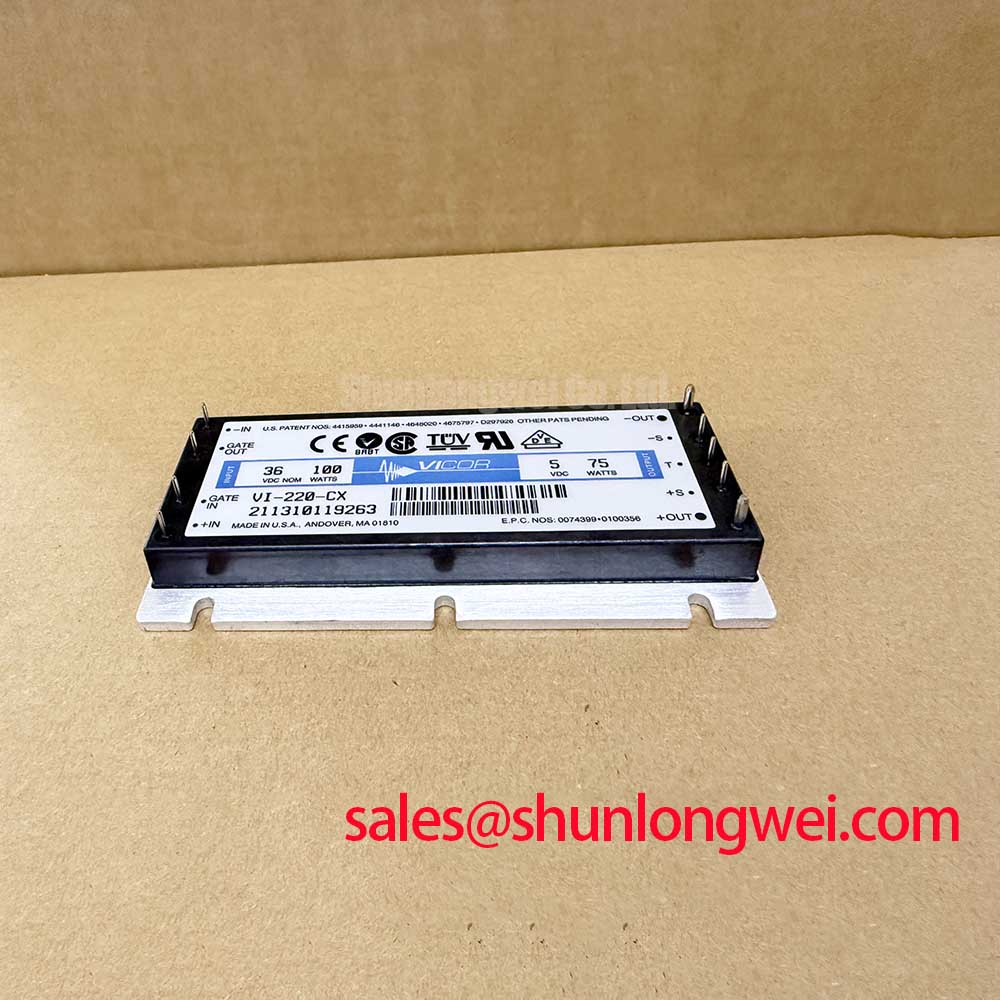
Vicor VI-B70-IW DC-DC Converter Module | High-Reliability 100V to 5V 100W Power Solution
The Vicor VI-B70-IW is a high-performance, industrial-grade DC-DC converter from the legendary VI-200 family, designed to provide isolated, regulated power for demanding systems. Featuring 100V DC nominal input and 5V DC output at 100W, this module utilizes Vicor’s patented Zero-Current Switching (ZCS) technology to deliver high power density with minimal electromagnetic interference (EMI). Its -40°C to +85°C operating temperature range makes it a critical component for power designers maintaining infrastructure in telecommunications, industrial control, and legacy automation systems where reliability is non-negotiable.
UVP Statement: This module serves as a thermal-resilient power cornerstone for 100V bus architectures, offering 3,000Vrms isolation and high-density 100W delivery in a compact, brick-style package.
- Core Specs: 100V DC Input (72-144V Range) | 5V DC Output | 100W Rated Power
- Key Benefits: Enhanced thermal stability via slotted baseplate; simplified EMI management through ZCS architecture.
- Problem Solving: How do I convert a high-voltage industrial bus to stable 5V logic power without massive heat sinks? The VI-B70-IW achieves this through high-frequency switching efficiency, significantly reducing the thermal footprint compared to traditional hard-switched converters.
For systems requiring high-efficiency power distribution in 100V environments, the VI-B70-IW is the optimal choice for ensuring stable logic-level supply under varying load conditions.
Application Scenarios & Value
Achieving System-Level Benefits in High-Reliability Industrial Infrastructure
In the realm of industrial control and telecommunications, engineers often face the challenge of deriving stable 5V logic power from unstable high-voltage DC buses. The VI-B70-IW excels in High-Fidelity Engineering Scenarios such as retrofitting legacy railway signaling equipment or remote telecommunications hubs. These environments often utilize a 100V DC nominal bus that can fluctuate significantly. The 72V to 144V wide input range of this module ensures that logic-level 5V DC remains steady, even during the transient voltage spikes common in heavy industrial start-up sequences.
The integration of the VI-B70-IW into a UPS (Uninterruptible Power Supply) or a central control cabinet simplifies the thermal design. Because the Zero-Current Switching topology minimizes switching losses, engineers can often reduce the size of the cooling assembly. When comparing different power stages, while this module focuses on precision DC-DC conversion, systems often pair it with high-power switching components such as the SKM300GA123D for the main motor drive or inverter stage to maintain overall high-efficiency power system performance. In Industrial 4.0 deployments, the 3,000Vrms isolation provides a necessary safety barrier, protecting sensitive microprocessor control units from high-voltage transients on the main supply line.
Key Parameter Overview
Decoding the Specs for Enhanced Thermal Reliability
The following table outlines the critical technical specifications for the VI-B70-IW, emphasizing how each parameter translates into tangible engineering value for system design.
| Parameter | Specification | Engineering Interpretation & Value |
|---|---|---|
| Input Voltage (Nominal) | 100V DC | Optimized for standard industrial and railway DC buses. |
| Input Voltage Range | 72V – 144V DC | Wide tolerance handles voltage drops and surges without output ripple. |
| Output Voltage | 5V DC | Stable logic-level supply for TTL and CMOS microcontrollers. |
| Output Power | 100W | High power density allows multiple logic boards from one module. |
| Isolation Voltage | 3,000Vrms | Provides a "firewall" protecting logic circuits from bus-side faults. |
| Operating Temperature | -40°C to +85°C | Industrial grade (I-Grade) for unconditioned outdoor enclosures. |
| Efficiency | Typically 80-90% | Reduces wasted energy, directly lowering cooling requirements. |
Download the VI-B70-IW datasheet for detailed specifications and performance curves.
FAQ
Addressing Engineering Challenges in Power Conversion
How does the 100W power rating impact thermal management in a sealed enclosure?
The VI-B70-IW is designed to transfer heat efficiently through its baseplate. With an efficiency rating near 85%, only about 15W of heat is dissipated at full load. In a sealed enclosure, the slotted baseplate (W-grade) allows for direct mounting to a chassis, utilizing the enclosure itself as a heat sink. This is critical for maintaining the -40°C to +85°C range in stagnant air environments.
Why is Zero-Current Switching (ZCS) relevant for EMI-sensitive medical or comms systems?
Traditional converters use "hard switching," which creates sharp current spikes and significant electromagnetic noise. ZCS technology ensures that the internal transistors switch only when the current is zero. This acts like a precision-timed relay runner, passing energy only when the "friction" (current) is zero, drastically reducing conducted and radiated EMI, which simplifies IEC 61800-3 compliance.
Can the VI-B70-IW handle input transients up to 150V?
While the official range is 72-144V, the module includes internal overvoltage protection. However, sustained operation at 150V exceeds the design specifications. For high-voltage transient environments, we recommend implementing a front-end snubber or surge suppressor to keep the input within the 144V limit for long-term reliability.
What is the primary benefit of the 3,000Vrms isolation in industrial HMI applications?
Isolation prevents ground loops and ensures that a catastrophic failure on the 100V bus side does not migrate to the 5V logic side. This protects expensive TFT-LCD panels and controllers from damage, lowering the total cost of ownership (TCO).
Is this module compatible with lead-free soldering processes?
Yes, the VI-B70-IW is RoHS compliant. However, due to its mass and the presence of the baseplate, engineers must follow specific thermal profiles during assembly to ensure consistent solder joints without overstressing the internal components.
Technical & Design Deep Dive
A Closer Look at ZCS Architecture and Thermal Conductance
The core innovation of the Vicor VI-B70-IW lies in its power conversion topology. Unlike standard PWM (Pulse Width Modulation) converters, the VI-200 series uses a MHz-frequency resonant converter. This high frequency allows for the use of much smaller magnetic components, contributing to its compact "half-brick" size. Think of the 3,000Vrms isolation as a high-strength firewall for electricity, ensuring that even if the primary side suffers a surge, the logic components on the secondary side remain isolated and unharmed.
From a thermal management perspective, the module’s internal Thermal Resistance is minimized through the use of high-conductivity potting materials. This is vital when the module is integrated into systems utilizing complex power semiconductor frameworks. The ZCS architecture acts like a precision-timed relay runner, passing energy only when the current is zero to minimize switching "friction" (heat), which is the primary cause of component aging in power electronics.
Industry Insights & Strategic Advantage
Sustainability and Continuity in Legacy Power Systems
As the industrial world pivots toward Industry 4.0, there is a growing need to bridge the gap between legacy 100V DC infrastructure and modern digital control. The VI-B70-IW represents a strategic asset for engineers who must ensure 24/7 uptime in systems that were designed decades ago but now require modern logic-level monitoring. By providing a 100W output in a standardized package, it allows for the addition of high-power sensors and IoT gateways without redesigning the entire power backplane.
Strategically, choosing a Vicor module provides a pathway to meeting modern efficiency standards even in older systems. As energy regulations become stricter, the transition from older, inefficient linear regulators to high-frequency converters like the VI-B70-IW becomes a necessity for reducing carbon footprints at the facility level. Engineers should consult comprehensive engineering guides to ensure that high-frequency modules are properly integrated to avoid interference with sensitive analog sensor traces.
Engineer’s Perspective: For designers tasked with maintaining 100V DC systems where thermal overhead is limited, the VI-B70-IW provides a proven, high-density solution that balances 5V regulation with exceptional electrical isolation.