Content last revised on September 10, 2026
2DI100Z-140 Fuji Electric Power Transistor Module: High-Voltage Darlington Engineering for Industrial Power Conversion
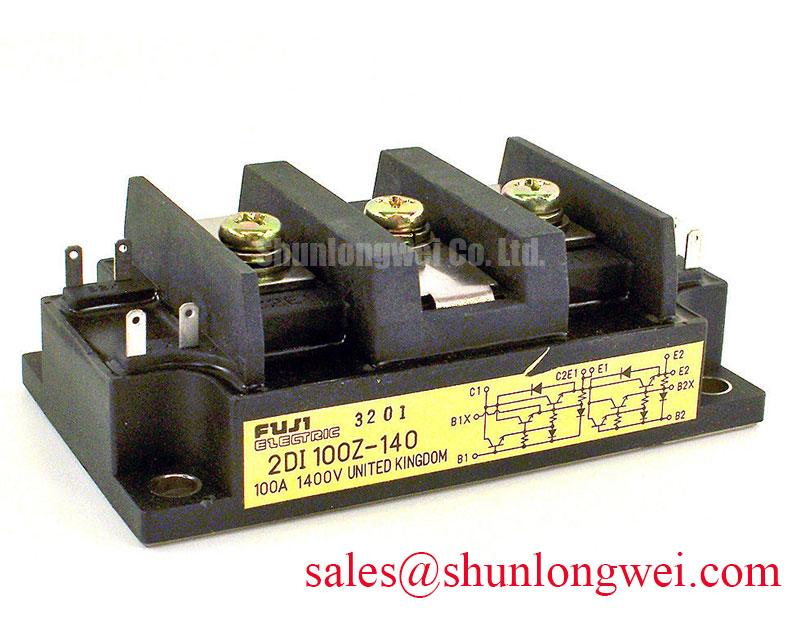
The 2DI100Z-140, a specialized member of the Fuji Electric Power Transistor family, is a dual-unit Darlington module engineered to provide a 1400V collector-emitter voltage and a 100A continuous collector current rating for high-stress switching applications. Designed specifically for industrial environments where voltage transients are frequent, this module bridges the gap between traditional power bipolar transistors and modern high-frequency switches by offering exceptional ruggedness and simplified drive requirements. What is the primary benefit of the 1400V Vces rating in the 2DI100Z-140? It provides a substantial safety margin against voltage transients in 400V-480V industrial power grids. For 480V systems prioritizing thermal margin and voltage overhead, this 1400V module is the optimal choice.
Application Scenarios & Value
Optimizing System Reliability in Heavy-Duty Power Grids
In the realm of industrial automation, the 2DI100Z-140 excels in AC Motor Drives and Uninterruptible Power Supplies (UPS). A common engineering challenge in these systems is the management of back-EMF and grid surges. When a large inductive load like a conveyor motor stops abruptly, the resulting voltage spike can easily exceed 1000V. By utilizing a module with a 1400V Vces, engineers ensure that the semiconductor operates well within its safe operating area, effectively preventing catastrophic breakdown without the need for overly complex snubber circuits. This headroom is particularly vital for systems operating on 480V mains, where rectified DC bus voltages can hover near 650V-700V.
For designers working on PFC stages or high-power inverters, the integration of a speed-up diode within the 2DI100Z-140 package reduces external component counts and parasitic inductance. While this model is ideal for high-voltage isolation in dual-switch topologies, systems requiring higher current handling might transition toward modules like the 1MBI600PX-140, which offers a 600A rating for more intensive loads. Conversely, for integrated three-phase rectification and switching in a single package, the 6DI100A-060 remains a frequent point of comparison for lower voltage 600V designs.
Key Parameter Overview
Decoding Technical Specifications for Enhanced System Density
Understanding the balance between switching losses and conduction capability is critical for selecting the right power module. The following parameters reflect the 2DI100Z-140's performance under standard operating conditions.
| Technical Parameter | Specified Value | Engineering Significance |
|---|---|---|
| Collector-Emitter Voltage (Vces) | 1400V | Provides superior protection against line transients in 400V/480V systems. |
| Collector Current (Ic) | 100A | Standardized for medium-to-large motor drive and industrial UPS applications. |
| Collector-Emitter Saturation Voltage (Vce(sat)) | 2.5V (Typical) | Determines conduction loss; lower values facilitate higher efficiency in low-frequency switching. |
| DC Current Gain (hFE) | 100 (Minimum) | Reduces base drive current requirements, simplifying the Gate Drive circuitry design. |
| Isolation Voltage (Viso) | 2500V AC | Ensures safe operation and compliance with international safety standards for chassis grounding. |
Technical & Design Deep Dive
The Darlington Advantage in High-Impedance Drive Circuits
The 2DI100Z-140 utilizes a classic NPN Darlington configuration, which is essentially two bipolar transistors connected so that the current amplified by the first is further amplified by the second. How does the Darlington configuration affect performance? It achieves high current gain with minimal base drive requirements, simplifying control circuitry. This is a critical distinction when compared to single-stage BJT modules, as it allows the 2DI100Z-140 to be driven by relatively low-power logic signals through a standard Gate Drive stage.
Think of the Darlington structure as a "current lever." Just as a small force on a long lever can move a heavy stone, a small base current (Ib) in this module can control a 100A load. This is especially useful in legacy industrial systems where control boards were designed before the ubiquity of high-current MOSFET drivers. For a broader comparison of how these structures stack up against newer technologies, see our comprehensive guide on power semiconductor selection.
Industry Insights & Strategic Advantage
Maintaining Infrastructure in the Era of Efficiency Regulations
As global industries pivot toward carbon neutrality and Energy Star standards, the maintenance of existing power infrastructure becomes a strategic challenge. The 2DI100Z-140 remains a vital component for the life-cycle management of Variable Frequency Drives (VFD) and renewable energy grid-tie systems installed over the last decade. Its ruggedness makes it a preferred choice for "maintenance and repair" (MRO) engineering where reliability is prioritized over the absolute highest switching speeds. In hazardous or remote environments, the ability of a Darlington module to survive a SCSOA event without failing is often more valuable than the incremental efficiency gains of a SiC alternative. For those tasked with diagnosing potential system issues, our field engineer's handbook on failure analysis provides essential diagnostic techniques.
FAQ
How does the 1400V rating of the 2DI100Z-140 benefit 480V AC motor applications?
In 480V systems, the DC link voltage typically reaches 675V. The 1400V rating provides more than 2x overhead, which is critical for absorbing the inductive flyback energy generated by AC Motor Drives during rapid deceleration or fault conditions, preventing semiconductor punch-through.
Can the 2DI100Z-140 be directly swapped for an IGBT module of similar current rating?
No. The 2DI100Z-140 is a current-controlled Darlington transistor, whereas an IGBT Module is voltage-controlled. Swapping would require a complete redesign of the Gate Drive and bias circuitry to accommodate the base current requirements of the Darlington pair.
What is the primary factor limiting the switching frequency of this module?
The storage time and fall time inherent to the Darlington structure generally limit the 2DI100Z-140 to switching frequencies below 5-10 kHz. Operating above this range significantly increases switching losses and thermal stress on the junction.
Does the module include internal protection against reverse current?
Yes, the 2DI100Z-140 features a built-in fast-recovery "speed-up" diode and a parasitic anti-parallel diode across the collector and emitter to protect the transistor from reverse-biased inductive spikes during the "off" state.
Strategically, choosing the 2DI100Z-140 involves balancing its robust high-voltage tolerance against its lower switching frequency limits compared to modern IGBTs. For existing industrial designs requiring the specific current-gain characteristics of a Darlington pair, this module remains a high-reliability cornerstone for maintaining grid stability and motor control integrity in demanding environments.