Content last revised on September 10, 2026
Harnessing Speed and Efficiency: A Technical Profile of the CM200DU-12NFH IGBT Module
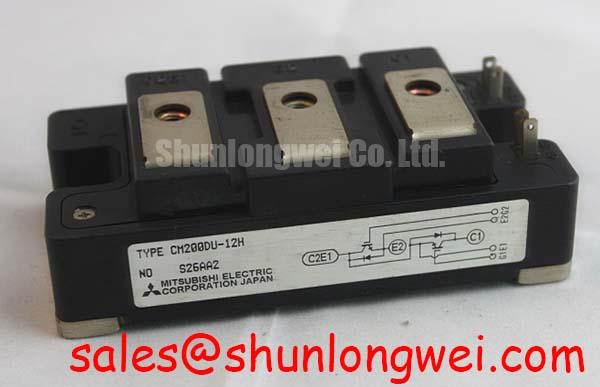
The CM200DU-12NFH is a high-speed, dual IGBT module engineered by Mitsubishi to minimize switching losses, enabling designers to achieve superior power density and efficiency in high-frequency power conversion systems. With core specifications of 1200V and 200A, and a typical VCE(sat) of 2.3V, this module offers a potent combination of performance characteristics. Its key benefits include enabling higher operational switching frequencies and improving overall system efficiency. By featuring exceptionally low turn-on and turn-off energy, the module directly addresses the critical engineering challenge of mitigating heat generation in compact, high-power designs. For medium-power inverters operating at elevated frequencies, the CM200DU-12NFH offers an exceptional balance of speed and efficiency.
Key Parameter Overview
Decoding the Specs for Enhanced Switching Performance
The electrical characteristics of the CM200DU-12NFH are tailored for applications where switching efficiency is a primary design driver. The parameters below, extracted from the official datasheet, provide the foundational data for system-level thermal and electrical modeling. The highlighted values are particularly decisive for high-frequency operation.
| Parameter | Symbol | Conditions | Value | Unit |
|---|---|---|---|---|
| Collector-Emitter Voltage | VCES | VGE = 0V | 1200 | V |
| Gate-Emitter Voltage | VGES | - | ±20 | V |
| Collector Current (DC) | IC | Tc = 25°C | 200 | A |
| Collector-Emitter Saturation Voltage | VCE(sat) | IC = 200A, VGE = 15V | 2.3 (Typ) / 2.8 (Max) | V |
| Turn-On Switching Energy | Eon | VDD = 600V, IC = 200A | 15 (Typ) | mJ/pulse |
| Turn-Off Switching Energy | Eoff | VDD = 600V, IC = 200A | 20 (Typ) | mJ/pulse |
| Thermal Resistance (Junction to Case) | Rth(j-c) | IGBT Part | 0.11 (Max) | °C/W |
| Operating Junction Temperature | Tj | - | -40 to +150 | °C |
Download the CM200DU-12NFH datasheet for detailed specifications and performance curves.
Application Scenarios & Value
Achieving System-Level Benefits in High-Frequency Power Conversion
The CM200DU-12NFH is engineered as a cornerstone component for modern power electronics where the reduction of switching losses is paramount. Its capabilities are best demonstrated in high-performance Variable Frequency Drives (VFDs). In this context, the module's fast switching times and low Eon/Eoff values allow engineers to increase the PWM frequency well above the human audible range (e.g., >16 kHz). This not only results in quieter motor operation—a significant advantage in commercial and industrial environments—but also enables the use of smaller, lighter, and more cost-effective output filter components. The result is a VFD that is more compact, acoustically superior, and boasts higher power density.
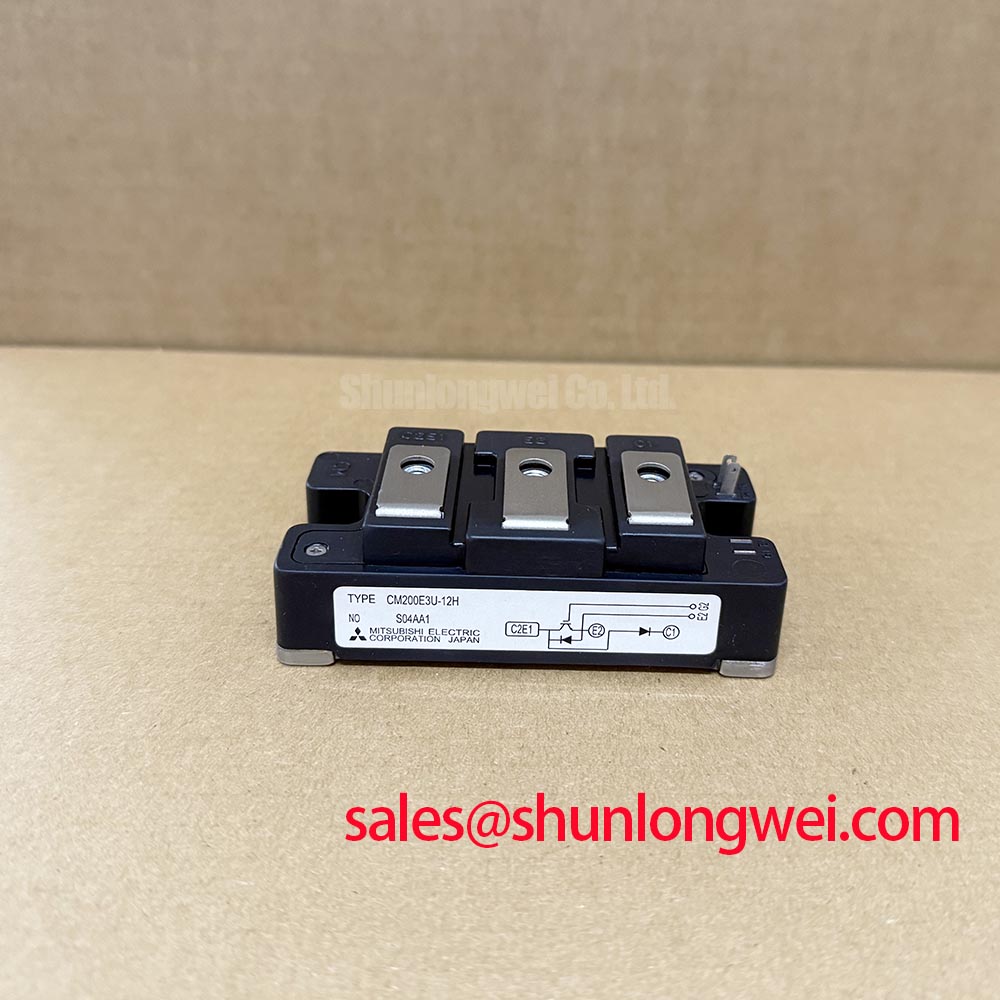
Beyond VFDs, this module is a prime candidate for Uninterruptible Power Supplies (UPS), high-frequency welding equipment, and solar inverters. In each of these applications, the 1200V collector-emitter voltage provides a robust safety margin for systems connected to 400V or 480V AC lines, while its 200A current rating supports significant power throughput. While the CM200DU-12NFH is ideal for 200A applications, systems demanding higher current capacity may consider the related CM300DU-12H, which offers a 300A rating in a similar voltage class.
Frequently Asked Questions (FAQ)
Engineering Insights into the CM200DU-12NFH
How do the low Eon/Eoff values of the CM200DU-12NFH translate to tangible system benefits?
Low Eon/Eoff values signify less energy dissipated as heat during each switching event. This directly reduces total switching losses, allowing for higher operating frequencies without thermal runaway. This enables designers to use smaller heatsinks and create more compact, power-dense systems, ultimately lowering bill-of-materials (BOM) cost and system size.
What is the significance of the 'NFH' designation in this IGBT module series?
The 'NFH' suffix in Mitsubishi's part numbering system typically denotes a High-Speed (H-Series) Insulated Gate Bipolar Transistor. This series is specifically optimized to minimize switching times and associated energy losses, making it distinct from other series that might prioritize lower conduction losses (VCE(sat)).
For a 200A module, what are the key considerations for the gate drive circuit to achieve optimal switching performance?
To fully leverage the high-speed nature of the CM200DU-12NFH, the gate drive circuit is critical. It must have high peak current capability to quickly charge and discharge the IGBT's gate capacitance, ensuring fast transitions. A layout with minimal parasitic inductance, often utilizing a Kelvin emitter connection, is essential to prevent voltage overshoots and ringing. A negative gate voltage during the off-state is also recommended to improve noise immunity.
How does the module's thermal resistance impact heatsink selection for a high-frequency application?
The Rth(j-c) of 0.11 °C/W (max) is a critical parameter. It quantifies how effectively heat can be transferred from the semiconductor junction to the module's case. In a high-frequency design where switching losses are dominant, this low thermal resistance ensures the generated heat can be efficiently moved to the heatsink. This allows engineers to either use a smaller heatsink for a given power dissipation or operate at a higher power level with the same cooling solution, directly impacting the final system's power density and reliability. For more on this topic, explore our guide to mastering IGBT thermal management.
The strategic selection of a high-speed module like the CM200DU-12NFH is more than a component choice; it's a system-level decision that unlocks competitive advantages in power density and efficiency. By integrating this device, engineering teams can develop next-generation power converters that are smaller, lighter, and more aligned with tightening energy standards, positioning their products at the forefront of the market.