
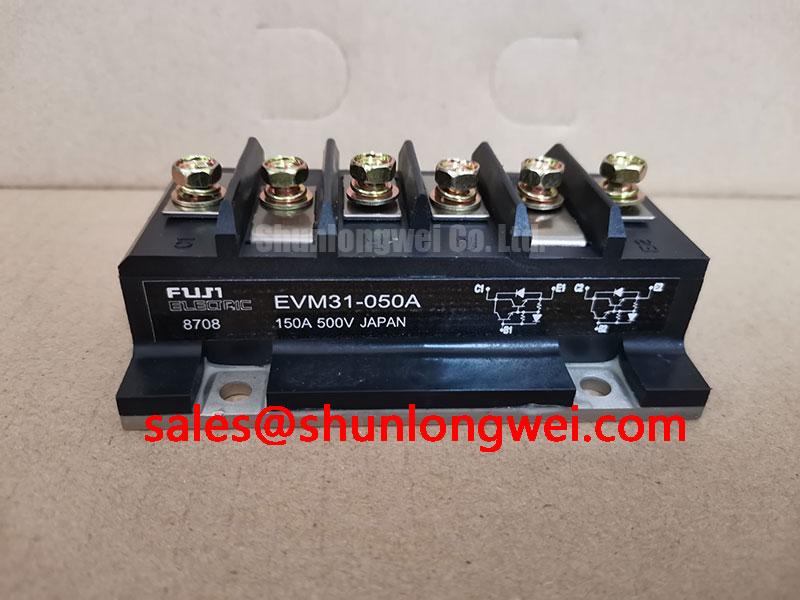
When selecting the right IGBT module for your industrial power applications, understanding the nuances between different models is essential. Here, we take a closer look at two high-performance products from Fuji Electric, the EVM31-050A and EVM31-050B. Both are robust IGBT modules, but they have certain distinct characteristics that make each suited to specific applications. This guide will outline their similarities and differences, helping you make an informed decision.
General Overview
IGBT (Insulated Gate Bipolar Transistor) modules, such as the Fuji EVM31-050A and EVM31-050B, are integral to high-efficiency power switching in systems like motor drives, inverters, and power converters. They combine the benefits of high-speed switching with the ability to handle high voltage and current loads, which is crucial in applications where energy efficiency and power density are priorities.

Technical Specifications
The table below provides a breakdown of the key specifications for each module:
| Feature | Fuji EVM31-050A | Fuji EVM31-050B |
|---|---|---|
| Voltage Rating | 500V | 500V |
| Current Rating | 150A | 150A |
| Configuration | Darlington, 2-Pack | General IGBT Configuration |
| On-State Voltage Drop | Low | Low |
| Switching Speed | High | High |
| Operating Junction Temp. | -40°C to +150°C | -40°C to +150°C |
| Package Type | Standard Fuji Packaging | Similar to EVM31-050A |
| Applications | Inverters, Motor Drives, Power Converters | General Industrial Power Applications |
Key Similarities
- High Voltage and Current Ratings: Both modules have a maximum voltage rating of 500V and a current rating of 150A, making them ideal for heavy-duty power applications. This ensures that both modules can handle high energy loads without compromising performance, which is essential in industrial settings.
- Durability and Temperature Range: With an operating temperature range from -40°C to +150°C, these modules are built to withstand harsh environments, ensuring reliability and longevity in industrial applications. Whether the system is used in extreme heat or cold, both models maintain their operational integrity.
- Energy Efficiency: Both IGBT modules offer low on-state voltage drop and fast switching speeds, minimizing power loss during operation. This makes them highly efficient, particularly in applications such as inverters and motor drives, where energy savings are critical.
- Compliance with International Standards: Both the EVM31-050A and EVM31-050B comply with RoHS (Restriction of Hazardous Substances) standards and other international certifications, ensuring environmental safety and usability across global markets.
Key Differences
- Module Configuration:
- EVM31-050A: This module features a Darlington 2-Pack configuration, which provides greater current gain and is specifically tailored for applications like precision motor drives and inverters. The Darlington configuration enables a high degree of control over current flow.
- EVM31-050B: While the specifics of the EVM31-050B configuration are less explicit, it is likely similar to that of the EVM31-050A but without the specialized Darlington setup. This makes it more of a general-purpose IGBT module.
- Application Focus:
- The EVM31-050A is tailored for applications where precise control of power is needed, such as in motor drives that require tight regulation of torque and speed. Its specialized configuration makes it particularly effective in DC-DC converters and inverters for renewable energy systems.
- The EVM31-050B, on the other hand, is better suited for general industrial power applications. It’s a versatile module that can be deployed in a wide array of power conversion systems where efficiency and reliability are priorities, but where precise control isn’t as critical.
- Performance in Different Use Cases:
- For high-efficiency applications such as renewable energy inverters, where power conversion is at a premium, the EVM31-050A shines due to its ability to handle rapid switching with minimal energy loss. It is designed to perform well in systems that demand continuous power adjustments based on varying load requirements.
- The EVM31-050B is more appropriate for general, heavy-duty industrial power uses, including large UPS systems (uninterruptible power supplies) and power converters. Its broader application scope , excellent choice for industries needing high power switching without the need for the additional benefits of the Darlington configuration.
Application Use Cases
- Inverters for Renewable Energy: Both models excel in inverter systems used in solar and wind power generation. Their ability to efficiently convert DC power from sources like solar panels into AC power makes them essential for grid integration.
- Motor Drives: The EVM31-050A is particularly well-suited for precision motor drives that need tight control over speed and torque, making it valuable in manufacturing and automation. The EVM31-050B, while also capable in motor drives, is generally used in less precision-sensitive systems.
- Power Conversion and UPS Systems: Both modules can be used in power conversion systems, such as those found in large industrial settings or backup power systems. The ability to switch high voltage and current efficiently allows for uninterrupted power supply during load variations.
Conclusion
When choosing between the Fuji EVM31-050A and EVM31-050B, your decision should be based on the specific needs of your system. If your application requires precise control over power, such as in motor drives or inverter systems, the EVM31-050A with its Darlington configuration is likely the better option. However, if you need a more general-purpose IGBT module that can handle a variety of industrial power conversion tasks, the EVM31-050B would be a solid choice.
Both models deliver excellent performance in high-power switching environments and comply with international safety standards, ensuring reliability across a broad range of industrial applications