Content last revised on September 10, 2026
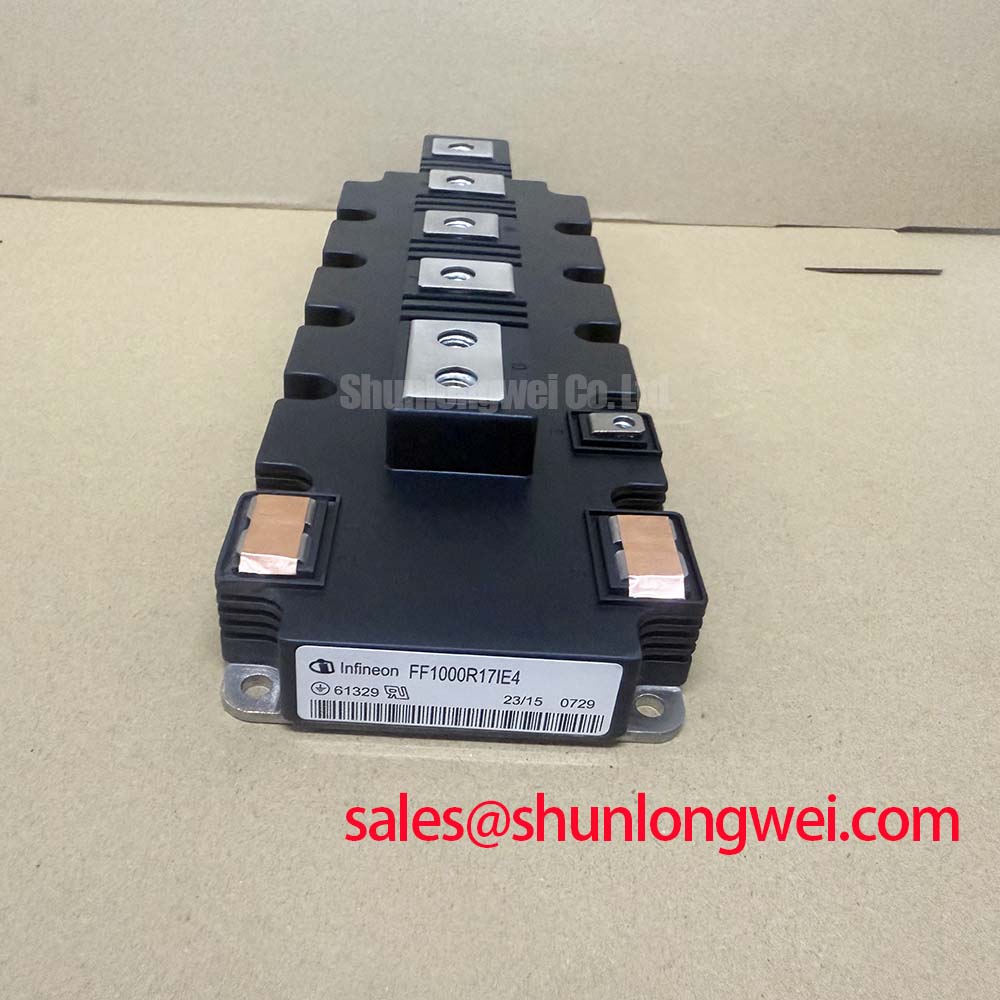
FF1000R17IE4P Infineon TRENCHSTOP™ IGBT4 PrimePACK™ 3 Module
How can power electronics engineers achieve a megawatt-class power density while ensuring the system survives a 20-year operational lifespan in harsh environments? This challenge is central to the design of modern wind turbine converters and heavy industrial drives. The FF1000R17IE4P is a high-performance 1700V, 1000A dual IGBT module from Infineon, specifically engineered to address the critical trade-off between switching capacity and thermal management. Featuring TRENCHSTOP™ IGBT4 technology and pre-applied Thermal Interface Material (TIM), it eliminates the variability of manual grease application, providing a standardized thermal path from the junction to the heatsink. For multi-megawatt wind power systems where junction temperature stability is the primary bottleneck, this 1000A PrimePACK module represents the benchmark for thermal reliability.
1700V | 1000A | 10.2 kV AC Insulation
Key Benefits: Optimized thermal resistance via pre-applied TIM; High power density in a PrimePACK™ 3 footprint.
What is the primary benefit of the 'P' suffix in this module? It signifies pre-applied Thermal Interface Material, which ensures consistent Rth(j-c) and prevents common failure modes related to uneven thermal grease application.
Frequently Asked Questions
Addressing Engineering Challenges in High-Power Switching
How does the pre-applied Thermal Interface Material (TIM) impact the long-term reliability of the FF1000R17IE4P?
The pre-applied TIM ensures a highly optimized and consistent thermal contact between the module's baseplate and the cooling surface. By eliminating manual application errors, it minimizes the risk of hot spots and reduces the overall thermal resistance, directly extending the power cycling capability of the IGBT Module under fluctuating loads.
What is the significance of the 10.2 kV AC 1min insulation rating for this 1700V module?
This exceptionally high isolation voltage is critical for high-altitude applications or systems requiring enhanced safety margins. It provides robust protection against transient overvoltages and ensures compliance with strict industrial safety standards in medium-voltage grid-connected systems.
How does the TRENCHSTOP™ IGBT4 chip technology contribute to energy efficiency?
The TRENCHSTOP™ IGBT4 technology reduces VCE(sat) to approximately 2.00V at 1000A (at 125°C). This lowers conduction losses, which is vital in high-current applications. Think of VCE(sat) as the internal friction of a high-capacity valve; a lower value means less energy is wasted as heat during the conduction phase.
Can the FF1000R17IE4P be used in 690V AC grid applications?
Yes, the 1700V collector-emitter voltage rating provides the necessary blocking voltage margin for 690V AC systems, accounting for DC bus voltage fluctuations and inductive switching spikes commonly found in wind-to-grid conversion.
What role does the integrated NTC thermistor play in system protection?
The integrated NTC provides real-time temperature feedback directly from the module. This allows the controller to implement proactive de-rating or shutdown protocols, preventing catastrophic failure due to over-temperature conditions, a crucial feature for unlocking IGBT thermal performance.
Key Parameter Overview
Specifications and Technical Value Interpretation
| Parameter | Value | Engineering Significance |
|---|---|---|
| Collector-Emitter Voltage (Vces) | 1700V | Ensures safe operation in 690V AC systems with significant voltage headroom. |
| Continuous DC Collector Current (Ic) | 1000A | Enables high-power output in a dual-switch configuration for large-scale inverters. |
| VCE(sat) (Tvj = 125°C) | 2.00V (typ.) | Minimizes conduction losses, facilitating higher system efficiency and lower cooling requirements. |
| Isolation Test Voltage | 10.2 kV | Provides superior dielectric strength for harsh industrial and renewable energy environments. |
| Max Junction Temperature (Tvj op) | 150°C | Allows for high-load operation while maintaining a reliable safety buffer. |
Download the FF1000R17IE4P datasheet for detailed specifications and performance curves.
Technical Deep Dive
Advanced Thermal Management and Package Resilience
The FF1000R17IE4P utilizes the PrimePACK™ 3 package, which is widely recognized in the industry for its optimized stray inductance and superior thermal performance. Central to its design is the integration of Infineon's TRENCHSTOP™ IGBT4 chips, which balance switching speed and softness to minimize EMI while maximizing throughput. For engineers, the Thermal Resistance (Rth) is the most critical metric; the pre-applied TIM technology reduces the contact resistance between the baseplate and heatsink to a near-theoretical minimum. Imagine the thermal path as a highway: manual grease application can create "potholes" (air gaps), whereas the pre-applied TIM creates a perfectly paved surface for heat to exit the junction efficiently.
Furthermore, the module’s RBSOA (Reverse Bias Safe Operating Area) is specifically tuned for high-power switching. This ensures that the module can safely turn off high currents even under inductive loads without triggering voltage breakdown. Detailed insights into these selection criteria can be found in our guide on the core trio of IGBT selection.
Application Scenarios & Value
Achieving System-Level Benefits in High-Frequency Power Conversion
In the renewable energy sector, particularly wind power converters, the FF1000R17IE4P is a primary choice for the generator-side and grid-side inverters. A common engineering challenge involves managing the Short-Circuit Withstand Time during grid-fault ride-through (GFRT) events. With its robust 10μs short-circuit capability, this module provides the necessary window for the Gate Drive system to detect a fault and safely shut down, preventing module explosion.
The module is also prevalent in heavy industrial Variable Frequency Drives (VFD) and traction applications. In these settings, the high current handling of 1000A allows for fewer paralleled modules, simplifying the mechanical busbar design and reducing the overall system footprint. For projects requiring lower current ratings but similar voltage protection, the FF600R17ME4 or the ff450r17me4 offer comparable 1700V reliability in smaller form factors. Integrating these modules into a system requires careful consideration of robust gate drive design to ensure long-term stability.
From an engineering perspective, the FF1000R17IE4P is not merely about its 1000A rating; it is about the predictability of its thermal performance. By standardizing the thermal interface, Infineon has removed one of the most common variables in power stack assembly, allowing designers to push the limits of power density with higher confidence in the system's MTBF (Mean Time Between Failures). When reliability in megawatt conversion is non-negotiable, this module provides the data-backed performance required for professional implementation.