
Content last revised on September 10, 2026
SKM145GB128D: Engineering High-Frequency Efficiency in Power Conversion
Introduction and Key Highlights
Balancing Conduction and Switching Performance for Optimal Design
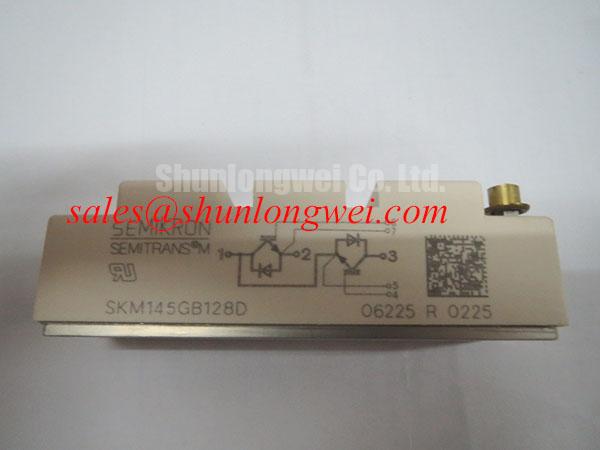
The SEMIKRON SKM145GB128D is a high-performance half-bridge IGBT module from the SEMITRANS® 2 family, engineered to deliver a superior balance between conduction and switching losses. It integrates Trench Field-Stop IGBT4 technology with a CAL (Controlled Axial Lifetime) freewheeling diode, offering a versatile solution for modern power converters. With core specifications of 1200V, 145A (at Tc=80°C), and a typical VCE(sat) of 1.9V, this module provides a robust foundation for efficient and reliable system design. Key engineering benefits include reduced overall power loss and simplified thermal management. The module's design provides a direct answer for engineers questioning how to optimize performance across variable load and frequency conditions, making it an excellent fit for demanding applications like variable frequency drives and solar inverters.
Application Scenarios & Value
Optimizing Drive Efficiency and Reliability in Demanding Loads
For systems like industrial motor drives, UPS systems, and solar inverters, the SKM145GB128D is an optimal choice when both efficiency and reliability are paramount. Its architecture excels in applications that experience a wide range of operating conditions. Consider a Variable Frequency Drive (VFD) controlling a conveyor system. During startup, the motor demands high torque at low frequencies, where low conduction losses—a benefit of the module's 1.9V typical VCE(sat)—are critical for efficiency. As the system reaches its nominal operating speed, the switching frequency increases, and the module's low Eon and Eoff energies from its Trench IGBT4 technology become essential for minimizing switching losses and managing heat. The integrated CAL freewheeling diode, with its soft recovery characteristic, mitigates voltage overshoots during switching transients, enhancing system reliability and reducing EMI. What is the primary benefit of its soft-recovery CAL diode? It ensures robust performance under inductive loads and simplifies protective circuit design. This combination of features enables designers to build more compact, efficient, and durable power conversion systems. For applications requiring lower current, the SKM75GB128D offers similar technology in a lower power package, while for higher power demands, the SKM200GB128D provides increased current handling capability.
Key Parameter Overview
Decoding the Datasheet for Balanced Performance Design
The technical specifications of the SKM145GB128D highlight its suitability for high-performance power electronics. The data below is grouped by function to aid in engineering analysis. Each value is critical for accurate simulation and robust design.
| Parameter | Value | Condition |
|---|---|---|
| Absolute Maximum Ratings | ||
| Collector-Emitter Voltage (Vces) | 1200 V | Tj = 25 °C |
| Continuous DC Collector Current (Ic) | 210 A | Tc = 25 °C |
| Continuous DC Collector Current (Ic) | 145 A | Tc = 80 °C |
| Total Power Dissipation (Ptot) | 1000 W | Tc = 25 °C, Tj = 150 °C |
| IGBT Characteristics (per switch) | ||
| Collector-Emitter Saturation Voltage (VCE(sat)) | 1.9 V (typ.) / 2.3 V (max.) | Ic = 145 A, VGE = 15 V, Tj = 25 °C |
| Turn-on Energy (Eon) | 21.0 mJ (typ.) | Ic = 145 A, VCE = 600 V, Tj = 125 °C |
| Turn-off Energy (Eoff) | 23.5 mJ (typ.) | Ic = 145 A, VCE = 600 V, Tj = 125 °C |
| Gate-Emitter Threshold Voltage (VGE(th)) | 5.8 V (typ.) | VGE = VCE, Ic = 5.6 mA |
| FWD Diode Characteristics (per switch) | ||
| Forward Voltage (VF) | 1.8 V (typ.) / 2.2 V (max.) | IF = 145 A, VGE = 0 V, Tj = 25 °C |
| Reverse Recovery Energy (Erec) | 12.5 mJ (typ.) | IF = 145 A, Tj = 125 °C |
| Thermal and Mechanical Characteristics | ||
| Thermal Resistance, Junction to Case (Rth(j-c)) | 0.15 K/W (per IGBT) | - |
| Operating Junction Temperature (Tj) | -40 to +150 °C | - |
Download the SKM145GB128D datasheet for detailed specifications and performance curves.
Technical Deep Dive
Inside the Trench IGBT4 and CAL Diode Synergy
The core of the SKM145GB128D's performance lies in the synergy between its Trench Field-Stop IGBT4 and the complementary CAL freewheeling diode. This combination is not just about individual component specs; it's about achieving a balanced system. The Trench IGBT4 technology can be compared to a modern turbocharged engine. While some designs are optimized purely for low-speed torque (low VCEsat) and others for high-revving power (low switching loss), the IGBT4 delivers strong performance across a wide operational range. This allows designers to avoid making hard compromises, achieving good efficiency in both high-current, low-frequency states and high-frequency operating modes.
Complementing the IGBT is the CAL diode, whose soft recovery characteristic acts like an advanced suspension system in a vehicle. When a conventional diode turns off under load, it can create a sharp, high-frequency oscillation, similar to the harsh jolt from hitting a pothole. This electrical "jolt" (voltage overshoot) stresses components and creates electromagnetic interference (EMI). The soft recovery of the CAL diode smoothly absorbs this transient energy, ensuring a stable voltage and preventing destructive oscillations. This inherent ruggedness simplifies or even eliminates the need for external snubber circuits, saving board space and component cost while contributing to a more reliable, long-lasting design. This integrated approach to thermal management and electrical stability is what sets this module apart for demanding applications.
Frequently Asked Questions
Engineering Insights for Practical Implementation
How does the integrated NTC thermistor in the SKM145GB128D contribute to system reliability?
The built-in NTC thermistor provides a direct, real-time measurement of the module's baseplate temperature. This allows the system's controller to implement precise over-temperature protection, preventing thermal runaway. It also enables dynamic performance management, such as scaling back the switching frequency or current if temperatures exceed a safe threshold, thereby maximizing operational uptime and extending the module's service life.
What is the practical benefit of the 'soft' recovery characteristic of the CAL freewheeling diode?
The primary benefit is enhanced system reliability and reduced EMI. Soft recovery minimizes voltage overshoot and oscillations during diode turn-off, which reduces stress on the IGBTs and other components. This leads to a lower probability of device failure and improves the system's electromagnetic compatibility, making it easier to meet regulatory standards like those for Variable Frequency Drives (VFDs) without requiring complex and costly external filter circuits.
To evaluate the SKM145GB128D for your next power conversion project or to secure components for your production line, please submit your inquiry for a direct quotation and availability details.