Content last revised on September 10, 2026
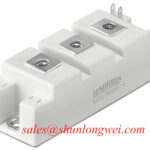
SKM50GB063D Semikron 600V 50A IGBT Module
How do power electronics engineers maintain high-efficiency switching in 400V DC bus systems without compromising on thermal ruggedness? The challenge often lies in finding a power module that balances low saturation voltage with the fast recovery characteristics required for high-frequency operation. The SKM50GB063D, a member of the renowned SEMITRANS 2 family, addresses this exact engineering hurdle by integrating Trench IGBT technology with a specialized CAL (Controlled Axial Lifetime) diode. For 400V drives prioritizing thermal margin and switching precision, this 600V rated module is the optimal choice.
The Semikron SKM50GB063D offers a Vces of 600V and a continuous collector current Ic of 50A at 25°C, tailored for heavy-duty industrial environments. By utilizing an isolated copper baseplate, the module ensures superior heat dissipation, which is critical for extending the lifespan of Variable Frequency Drives (VFD) and Uninterruptible Power Supplies (UPS). As a distributor focused on technical empowerment, we provide the following data to support your system-level evaluation and procurement decision-making.
Frequently Asked Questions
Engineering Solutions for Common Design Challenges
How does the Trench IGBT technology in the SKM50GB063D impact total power dissipation?
The Trench IGBT structure significantly reduces the collector-emitter saturation voltage (Vce(sat)) to approximately 1.45V. This lower conduction loss, combined with optimized switching characteristics, allows engineers to reduce the size of the required heatsink or increase the power density of the overall system. This is particularly beneficial in space-constrained enclosures for Servo Drives.
What is the primary benefit of the integrated CAL diode during inductive load switching?
The integrated CAL (Controlled Axial Lifetime) freewheeling diode is engineered for soft-recovery behavior. This minimizes peak reverse recovery currents and electromagnetic interference (EMI), ensuring compliance with IEC 61800-3 standards. This "softness" prevents high-voltage spikes that could otherwise stress the IGBT gate insulation during high-speed turn-off cycles.
Key Parameter Overview
Functional Grouping of Technical Specifications
| Absolute Maximum Ratings (Tvj = 25°C) | |
|---|---|
| Collector-Emitter Voltage (Vces) | 600V |
| Continuous Collector Current (Ic @ Tc=25°C) | 50A |
| Continuous Collector Current (Ic @ Tc=80°C) | 40A |
| Pulsed Collector Current (Icp) | 100A |
| Electrical Characteristics (Typical) | |
| Saturation Voltage (Vce(sat) @ Ic=50A) | 1.45V |
| Gate-Emitter Threshold Voltage (Vge(th)) | 5.8V |
| Input Capacitance (Cies) | 3.1nF |
| Turn-off Energy Loss (Eoff) | 1.1mJ |
| Thermal & Mechanical Data | |
| Thermal Resistance (Rth(j-c) IGBT) | 0.60 K/W |
| Operating Junction Temperature (Tvj) | -40°C to +150°C |
| Isolation Voltage (Visol) | 2500V AC |
| Package Style | SEMITRANS 2 |
Download the SKM50GB063D datasheet for detailed specifications and performance curves.
Technical Deep Dive
A Closer Look at Trench Gate Physics and Thermal Efficiency
The SKM50GB063D leverages a vertical trench gate structure, which acts like a "multi-lane expressway" for charge carriers compared to the older planar designs. In a traditional planar IGBT, current flow is constricted near the surface, leading to higher resistance. By etching a "trench" into the silicon, Semikron increases the channel density, allowing the module to handle higher current densities with a lower Vce(sat). This physical optimization directly translates to a reduction in thermal load per square millimeter of silicon.
Furthermore, the SEMITRANS 2 housing is a masterclass in thermal management. Imagine the baseplate as a high-speed drain for heat; the direct copper bonding (DCB) technology used here ensures that the Rth(j-c) remains as low as 0.60 K/W. For engineers, this means that even under transient overloads, the junction temperature Tvj stays within the safe operating area (SOA), preventing catastrophic thermal runaway. Understanding these IGBT selection nuances is vital for long-term system reliability in 24/7 industrial operations.
Effective Thermal Management is not just about the module; it involves the synergy between the baseplate and the thermal interface material. For more insights on optimizing your cooling strategy, refer to our guide on IGBT design integration.
Application Scenarios & Value
Achieving System-Level Benefits in High-Frequency Power Conversion
The SKM50GB063D is widely deployed in Variable Frequency Drives (VFD) where motor control precision is paramount. In these applications, the module's ability to switch at frequencies up to 15-20 kHz allows for smoother torque curves and reduced acoustic noise in industrial motors. The 600V rating is specifically optimized for three-phase systems operating on 230V or DC link voltages common in solar string inverters.
In Uninterruptible Power Supply (UPS) systems, the low switching losses of the SKM50GB063D contribute to high energy-star ratings. Designers often utilize this module in the inverter stage to convert DC battery power back into clean AC sine waves. For engineers designing larger industrial systems that require higher current handling, the related SKM75GB128D offers a higher current rating within a similar 1200V architecture, while the SKM150GB123D provides even greater power throughput for utility-scale applications.
By integrating the SKM50GB063D, OEMs can achieve a balance between Power Cycling Capability and cost-effectiveness. This is especially relevant in the context of renewable energy deployments, where reliability over a 15-year lifecycle is a non-negotiable requirement. Whether you are building a specialized medical power supply or a standard industrial conveyor controller, the SKM50GB063D offers a proven, standardized platform for high-performance power switching.
Strategic adoption of Trench IGBT modules like the SKM50GB063D enables a clear path toward meeting modern efficiency mandates and Carbon Neutrality goals. By minimizing energy waste at the component level, engineers can deliver more robust, sustainable products to the global market. For deep-dive comparisons of various semiconductor technologies, explore our analysis of power semiconductor selection.