Content last revised on September 10, 2026
Mitsubishi CM50MD-12H Integrated CIB IGBT Module
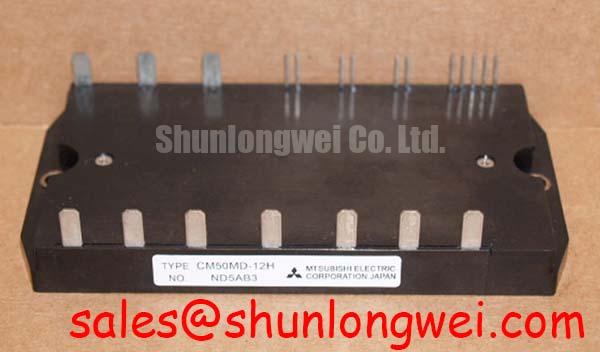
How do power electronic engineers eliminate parasitic lead inductance and thermal bottlenecks in compact motor drive designs without inflating PCB footprint? Integrating separate rectifier bridges, six-pack inverter stages, and dynamic braking choppers frequently leads to severe interconnect complexity and localized heat accumulation. The CM50MD-12H from Mitsubishi Electric addresses this challenge by combining a three-phase diode converter, a three-phase IGBT inverter, and a brake chopper into a single insulated package. For 220V AC three-phase motor drives requiring compact power integration, the 600V 50A CM50MD-12H module is the optimal engineering choice.
Featuring key absolute maximum ratings of 600V collector-emitter voltage, 50A continuous collector current, and 2500V AC isolation voltage, this module streamlines board layout while providing robust galvanic isolation. What is the primary benefit of the CM50MD-12H integrated CIB layout? It reduces parasitic inductance and saves PCB footprint in compact motor drives. By incorporating discrete super-fast recovery free-wheel diodes across each switching channel, the module minimizes switching transients and overall dynamic losses.
Frequently Asked Questions
Engineering Solutions for Gate Drive, Thermal Dissipation, and Integration
How does the low VCE(sat) characteristic of the CM50MD-12H impact system thermal design?
The module delivers a low collector-emitter saturation voltage (typically 2.8V at 50A), which directly lowers conduction losses across the inverter transistors. Reduced heat dissipation allows power supply designers to shrink the required aluminum heatsink volume, enabling higher overall power density in enclosed industrial control cabinets.
Why is a negative gate voltage recommended during the turn-off phase of the inverter stage?
Applying a negative gate voltage (such as -5V to -15V) during turn-off prevents unwanted turn-on caused by high dv/dt transients across the gate-collector Miller capacitance. This ensures high noise immunity during high-frequency switching operations in noisy industrial environments.
What design precautions prevent thermal stress in the integrated converter section?
Because the converter bridge rectifies three-phase AC power continuously, thermal grease must be uniformly applied between the copper baseplate and the heat sink. Maintaining proper mounting torque (0.98 to 1.47 N·m using M4 screws) minimizes thermal resistance and prevents localized junction temperatures from exceeding the maximum rating of 150°C.
Key Parameter Overview
Decoding Ratings for Integrated Converter-Inverter-Brake Topologies
| Parameter | Symbol | Test Conditions / Stage | Rated Value |
|---|---|---|---|
| Collector-Emitter Voltage | VCES | Inverter / Brake Stage, Tj = 25°C | 600V |
| DC Collector Current | IC | Inverter Stage, Tc = 25°C | 50A |
| Repetitive Peak Reverse Voltage | VRRM | Converter Diode Section | 800V |
| Gate-Emitter Voltage | VGES | C-E Short, All IGBTs | ±20V |
| Collector-Emitter Saturation Voltage | VCE(sat) | IC = 50A, VGE = 15V, Tj = 25°C | 2.8V (Typ) |
| Isolation Voltage | Viso | AC 1 minute, Main Terminal to Baseplate | 2500V AC |
| Module Weight | W | Typical value | 100g |
Download the CM50MD-12H datasheet for detailed specifications and performance curves.
Technical Deep Dive
Optimizing Thermal Resistance and Gate Drive Dynamics in Compact CIB Topologies
The integrated Converter-Inverter-Brake (CIB) architecture of the CM50MD-12H eliminates internal wiring loop delays that traditionally plague discrete power stages. By co-packaging a 3-phase diode bridge rectifier, a 6-pack IGBT inverter, and a brake chopper within a single insulated housing, internal stray inductance is dramatically suppressed. This structural optimization dampens voltage overshoots during high-speed switching transitions, enabling reliable operation up to 20 kHz switching frequencies.
Thermal management is central to long-term power stage endurance. Think of the module's direct-bonded copper substrate as a multi-lane thermal highway, rapidly transferring heat generated inside the silicon die out to the metal baseplate. When designing custom driver boards, incorporating robust IGBT gate drive designs with proper decoupling is essential. Operating the gate drive without localized bypass capacitance is like driving a high-speed vehicle with an unsteady fuel line—it risks inducing destructive switching oscillation under heavy motor loads.
Understanding internal chip layout also aids in preventing catastrophic short circuits. Designers selecting between integrated modules and discrete layouts can review our guide on IPM vs. discrete IGBT power design to analyze structural efficiency benefits. In high-demand motion control, the fast reverse recovery time of the anti-parallel free-wheel diodes keeps switching losses minimal, maintaining stable operation even under rapid acceleration and deceleration cycles.
Application Scenarios & Value
Streamlining Motor Drives and Industrial Automation Systems
The CM50MD-12H is widely deployed in industrial automation equipment where physical enclosure space is strictly limited. In variable frequency drives (VFDs) operating from standard 220V AC input lines, the internal 3-phase bridge rectifies incoming line power into a steady DC bus voltage. The six inverter switches synthesize high-precision AC waveforms to control induction motors, while the built-in brake transistor dissipates regenerative energy during sudden motor deceleration.
Typical applications include robotic arm joint drives, conveyor system controllers, packaging machinery, and automated HVAC compressors. In these environments, the module's 2500V AC isolation rating ensures compliance with international safety standards without requiring external ceramic insulators on the heat sink assembly. Engineers evaluating power semiconductor selection for different system topologies can refer to our detailed IGBT vs MOSFET vs BJT selection guide.
For systems operating on higher line voltages or demanding different topology layouts, alternative options exist within our portfolio. For 1200V three-phase inverter applications, the related FP50R12KT4 provides a 1200V CIB solution. For designs requiring isolated half-bridge configurations, the CM50DY-24H offers a 1200V dual IGBT topology. Furthermore, for equipment demanding significantly higher current handling at 600V, the related CM300DU-12H delivers a 300A current rating.
Contact our technical sales team today to request pricing, verify available stock, or discuss engineering data for your next power converter design.